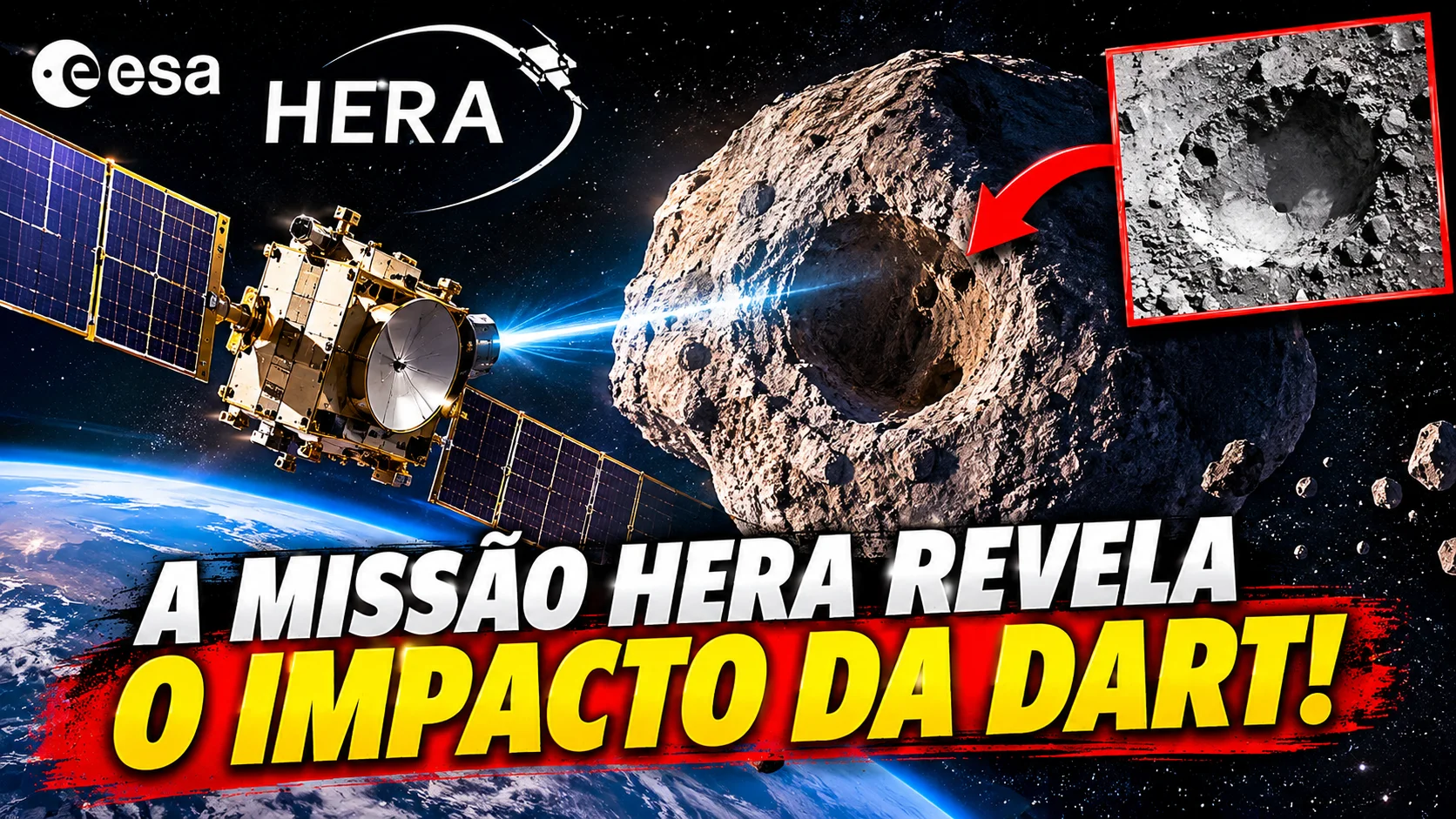
The Hera mission reveals the deep damage from the DART probe's impact on Dimorphos
Por Henrique Duarte ·
The complex binary system of Didymos and Dimorphos
Recent exploration of Near-Earth Objects has brought fascinating details about a pair of binary celestial bodies heavily studied by astronomical science. This set consists of two main asteroids: Didymos, the larger celestial body with approximately seven hundred and fifty meters in diameter, and its smaller companion, Dimorphos, which has about one hundred and fifty meters.
These asteroids orbit each other in a well-defined orbital trajectory, functioning as a natural laboratory in deep space to test our reaction capabilities against terrestrial external threats. By studying this pair, researchers can observe how collisions influence spatial structures without the risks involved in experiments on our own planet.
How the structure of the debris piles works
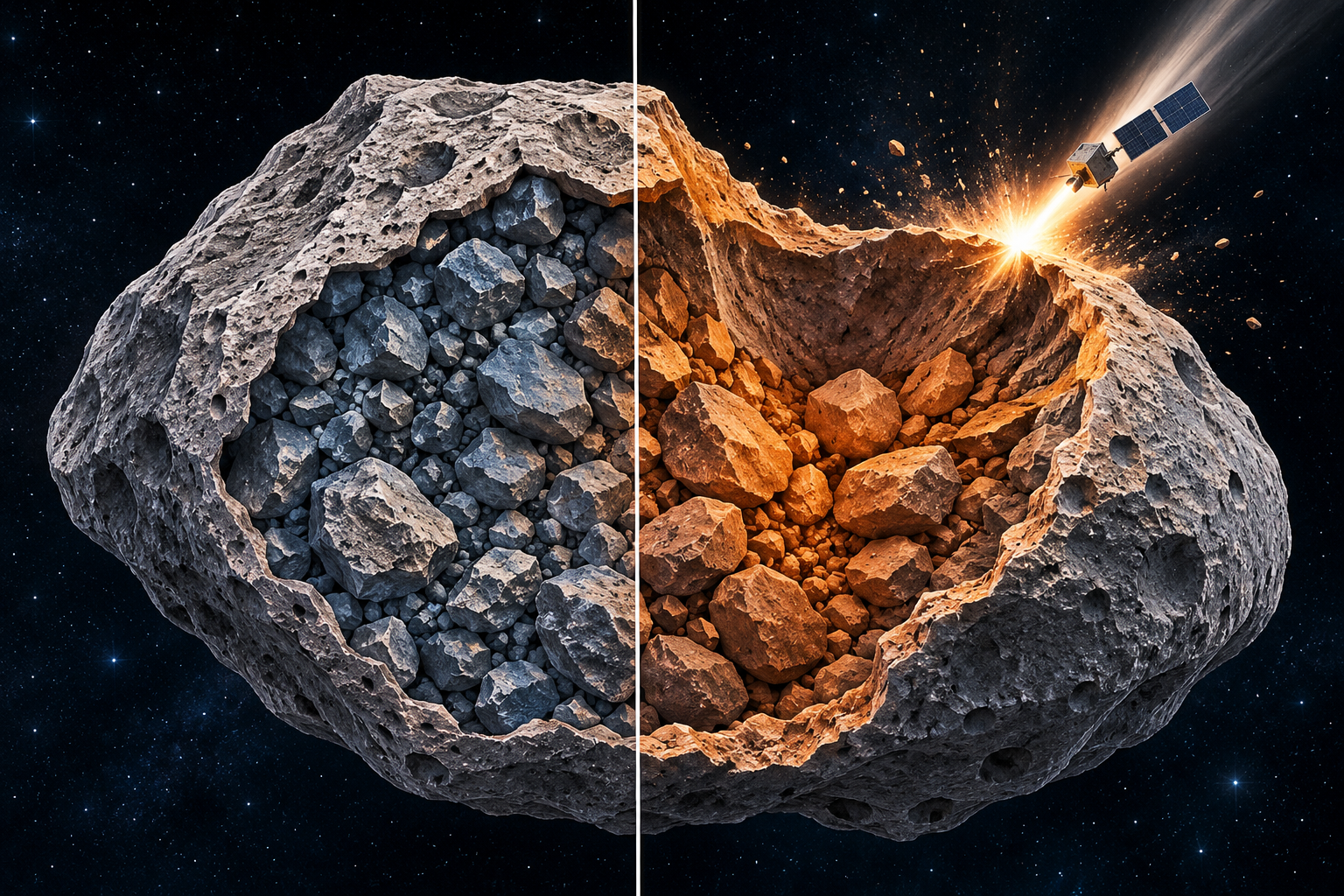
To understand the visible changes on the surface of these bodies, it is essential to understand their unique internal composition. Both are scientifically classified as "rubble piles," meaning they are not solid, massive blocks of rock compacted by internal geological processes.
Think of these asteroids as mountains built through the accumulation of loose pebbles and irregular fragments held together only by the low force of local gravity. This characteristic makes them function almost like small piles of unmortared bricks; although they remain together during space flight, each individual stone maintains a certain freedom of movement within the overall pile.
The dynamics of irregular wobbling movements
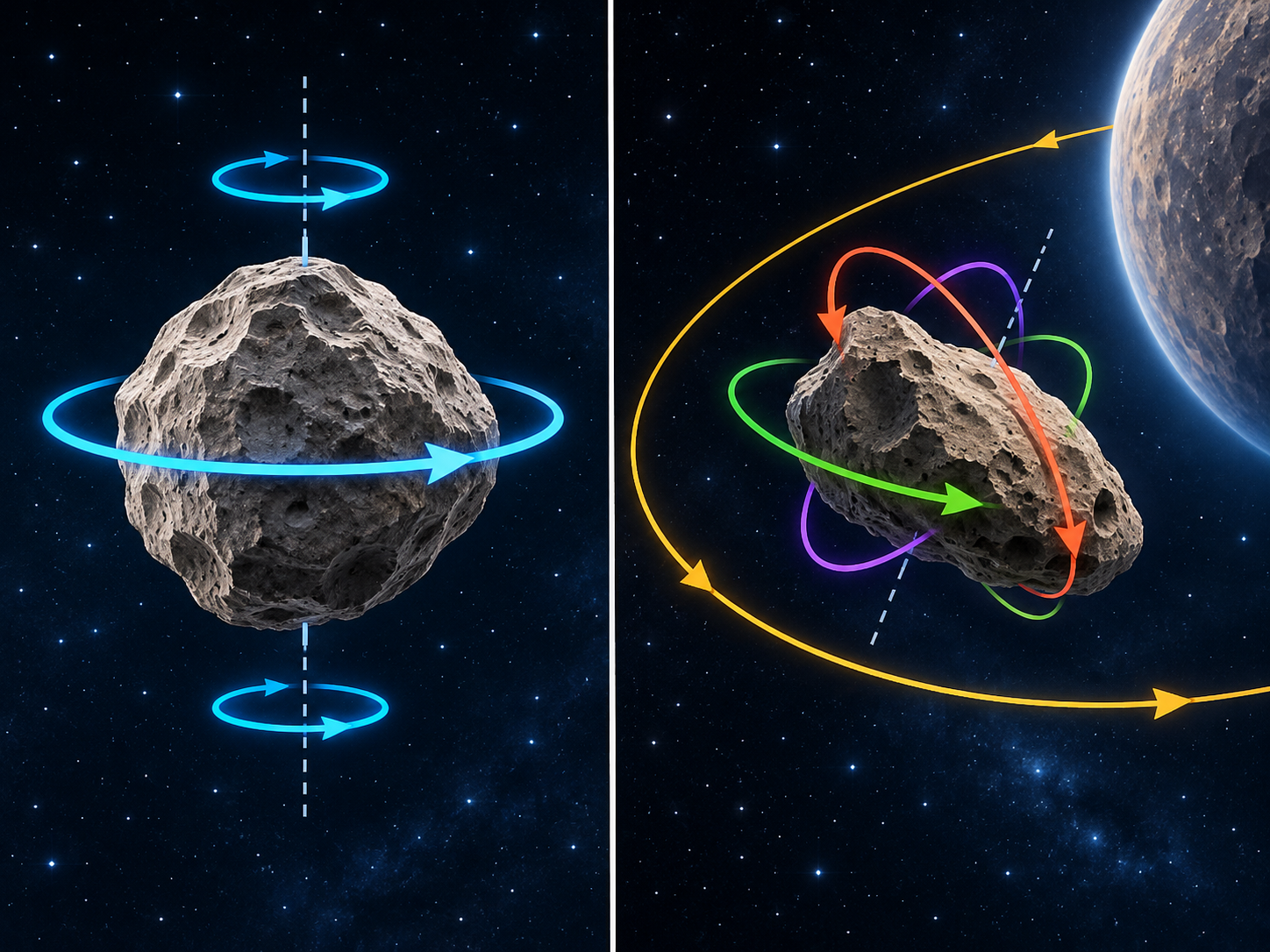
An important technical discovery made by the European agency concerns the complex rotational behavior of Dimorphos during its binary orbit. Instead of rotating constantly and predictably around its central axis, the asteroid exhibits a phenomenon called orbital tumbling or wobbling.
This means that it spins on its own axis while orbiting Didymos randomly, constantly changing the exposed face to external observers in space. This disordered rotation significantly complicates attempts at precise photographic capture, as scientists must use multiple images taken at different times to reconstruct a clear view of the previous impact.
The real damage caused by the NASA DART project
One of the central objectives of the mission launched years ago was to test whether it is possible to drastically alter the trajectory of dangerous objects through planned collisions by manned or automated spacecraft. The DART probe successfully hit the smaller body of the system, but we now have new data on the exact magnitude of that impact.
The new perspectives provided show that the impact did not just create a superficial mark on the rocky surface, but caused deep structural damage to Dimorphos. The visual result reveals a gigantic crater that covers almost the entire diameter of the asteroid, transforming its original oval shape into a scene of deep destruction and total physical remodeling.
The formation of internal mountains and blocks in the center of the crater
Within this new geological structure created by the space collision, researchers identified intriguing details such as large mounds and rocks projected into the interior of the new deep valley. This happens because the kinetic energy transferred by the spacecraft destabilized the loose components of the debris pile toward the area impacted by the shock.
In structures of this type, when a violent external force occurs, the internal rocks are rapidly displaced until they find equilibrium in new locations within the celestial body itself. These central "mountains" form as the matter is pushed or repositioned by the initial shockwave, revealing how fragile the internal organization of these smaller asteroids is.
The dangerous environment filled with small orbital fragments
In addition to the permanent marks on the surface of the two main bodies, the mission also detected something surprising about their immediate vicinity: the system is not empty or clean during its orbital passage. The instruments captured clear evidence of numerous smaller fragments that are continuously being ejected by the asteroids.
Due to the extremely low gravity inherent in the piles of debris, any small rotational movement causes the natural detachment of these tiny rocks and large blocks called boulders. These fragments now orbit freely around the binary pair, creating a constant space debris field that serves as a warning for future robotic missions, as any contact with these erratic objects could compromise the ship's vital systems.
Gathering data for terrestrial planetary defense
The main scientific importance of this new assessment lies in the fact that we finally have a precise scale regarding the real results of this simulated collision. By knowing exactly the dimension of the crater produced relative to the initial size of the probe, the exact impact velocity, and the total altered mass of the object.
This fundamental information allows scientists to perform more rigorous calculations regarding strategies for protecting against global space threats. With this consolidated empirical data, it is possible to design larger vessels or adjust specific velocities to deflect dangerous trajectories should any of these celestial bodies come on a direct course toward Earth