Reality Beyond the Atoms: What Composes Us in Quantum Physics
Por Henrique Duarte ·
Way Beyond Classical Lessons
Often, when we talk about quantum physics, our minds jump to iconic concepts like Schrödinger's cat or the uncertainty principle. While these ideas are fascinating historical milestones, they represent an early phase of a development that has been ongoing for almost a century. The scientific field has advanced significantly since the 1930s, bringing deeper answers about the fundamental nature of reality.
To understand this evolution, we first need to look at the basic model taught in schools: everything is made of atoms. Inside them, we find protons and neutrons in the nucleus, surrounded by electrons. More deeply, we discovered that protons and neutrons are formed by smaller particles called quarks—specifically the "up" and "down" types. In this simplified view, you, your cell phone, and the stars would be built from three basic pieces of this set.
Where the Original Equation Hit Its Limits
The famous Schrödinger equation was revolutionary because it described the electron's behavior not as a small ball on a fixed trajectory, but as a wave distributed around the nucleus called the wave function. The analogy here would be like the strings of a guitar tied at both ends; they can only vibrate at specific notes. This perfectly explains why electrons occupy defined energy levels, allowing us to understand the colors of neon lights and how modern transistors work.
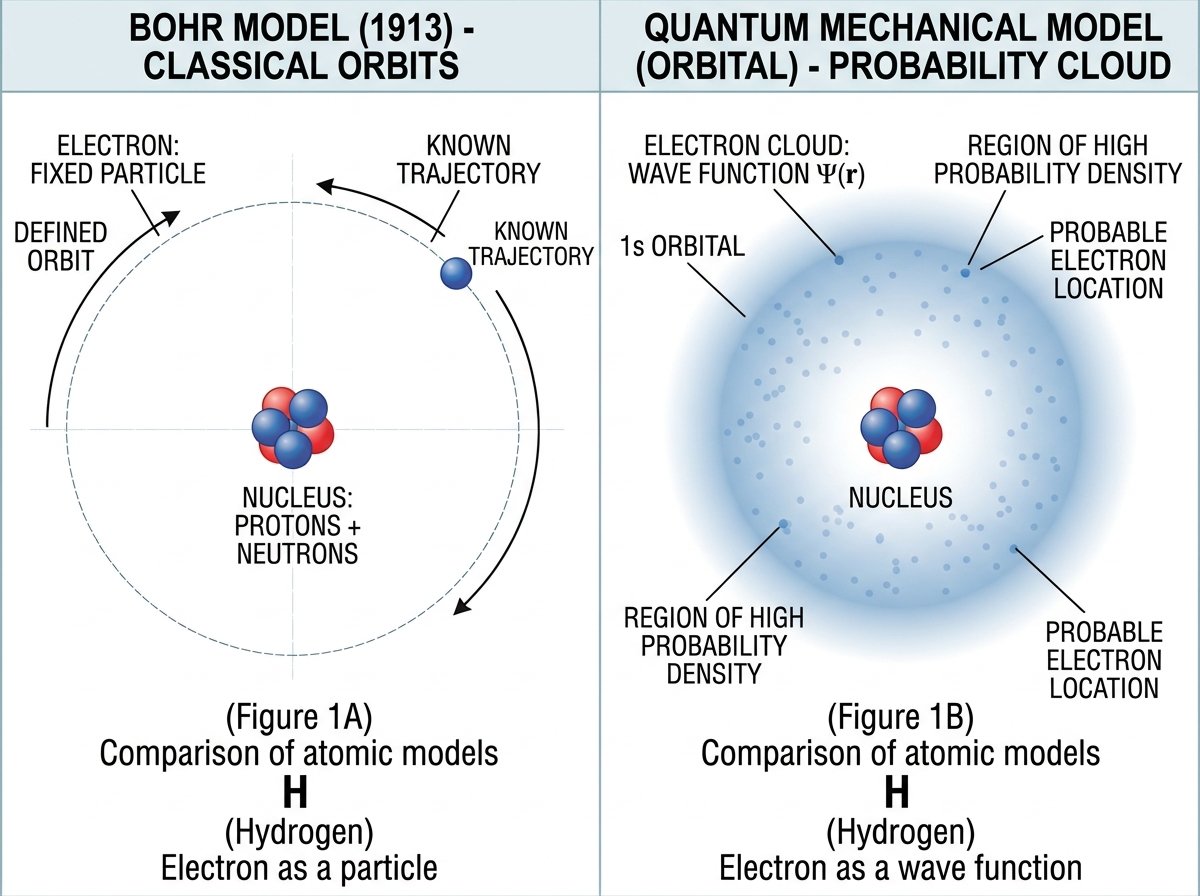
However, this model has a crucial limitation: it assumes a fixed number of particles. It works well for stable systems, where nothing suddenly appears or disappears. The problem arises when we try to explain phenomena like the sudden creation of photons, which are packets of light. By the logic of the pure equation, if you start with a single electron in the atom, you should end up with only one. But in reality—as we see in large particle accelerators—energy can transform into matter, causing new particles to emerge "out of nowhere.
The Leap to Field Theory
This gap was filled by the physicist Paul Dirac, who introduced the revolutionary concept of the field. A field is something that has a value at every point in space, functioning similarly to the temperature of a room (which varies from place to place) or the magnetic field between magnets. Instead of treating electrons and photons as small solid balls traveling independently, Dirac proposed that quantum rules should be applied to the fields themselves.
In this new paradigm, the photon is not a solid object, but rather the smallest possible ripple of the electromagnetic field. Similarly, there is an "electron field" that permeates the entire universe, including the interior of galaxies and the palm of your hand. Each individual electron would therefore be a quantized vibration of this same universal field. This explains why all electrons in the cosmos are absolutely identical: they are all manifestations of the same fundamental structure at different points in space.
The Vibrant Nature of the Vacuum
One of the strangest consequences of this view is that the "vacuum" is never truly empty. If everything is made of fields and these fields follow the uncertainty principle, they cannot remain perfectly static. Even in the emptiest point of the universe, constant fluctuations are happening in the fields. This phenomenon is not just theoretical; it can be measured through the Casimir effect, where two very close metal plates attract each other due to the pressures of these fluctuations in the vacuum between them.
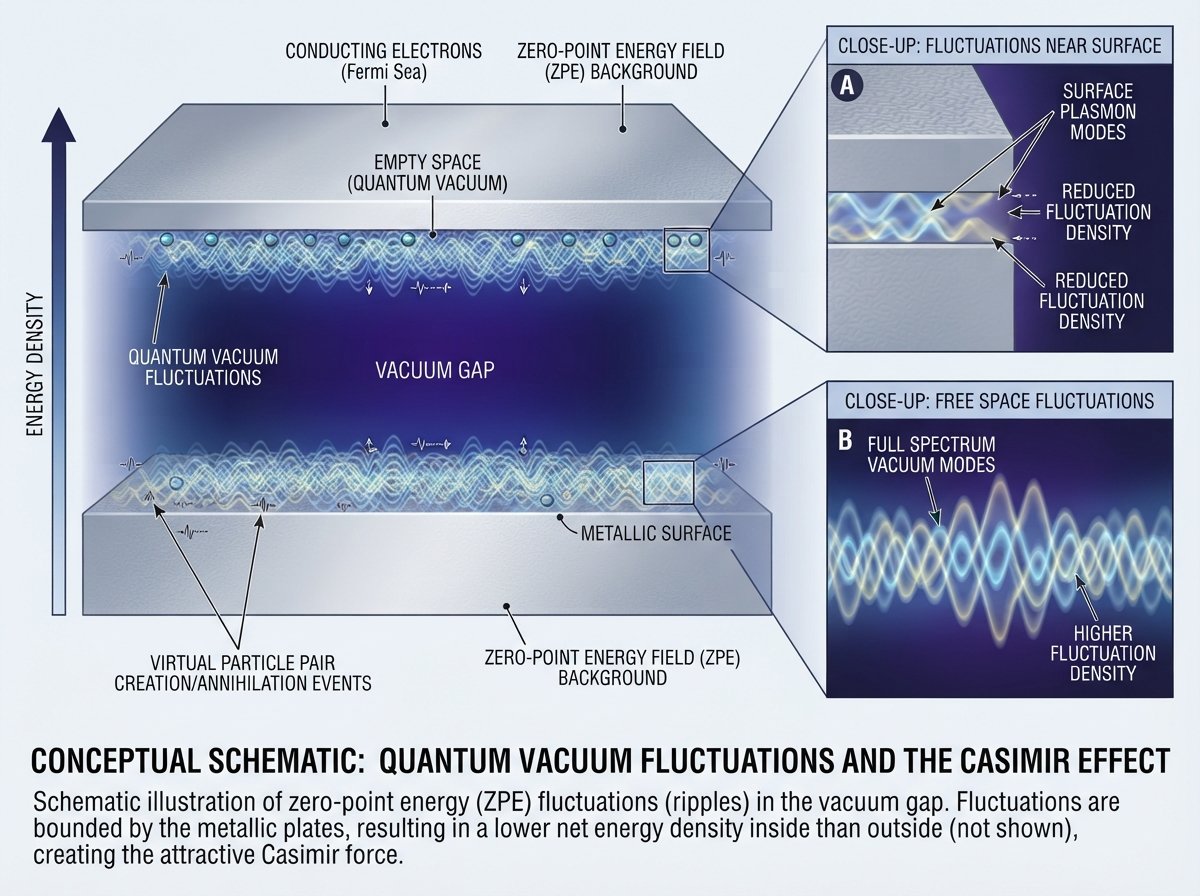
To deal with these mathematical complexities, scientists like Richard Feynman had to find innovative ways to solve calculations that initially resulted in infinite values. The effort to tame this mathematics allowed for extremely precise predictions about quantum physics. A striking example was the measurement of the electron's magnetic moment, whose theoretical prediction matched almost perfectly with experimental observations up to the eleventh decimal place—a level of accuracy comparable to measuring the distance between the Earth and the Moon with an error margin of less than half a millimeter.
The Architecture of the Standard Model
Currently, our best description of this reality is called the Standard Model. It organizes the 12 fundamental matter fields (divided into three families) and the force fields: electromagnetism, the strong force (which binds quarks), the weak force (responsible for radioactivity), and the Higgs field. The discovery of the Higgs boson confirmed that this last field interacts with other particles to give them mass, but there is an important detail about how things weigh.
It is often said that the Higgs gives "mass" to everything, but in the case of protons, this only accounts for about one percent of their total composition. The other ninety-nine percent comes from the internal energy of the movement of gluons and quarks inside the nucleus. Ultimately, almost all the mass of your body does not come from small solid objects, but rather from the energy of these vibrating fields interacting intensely with each other.
Where Current Science Ends
Although the Standard Model is incredibly precise, it still leaves significant gaps open. For example, gravity—described by Einstein as the curvature of spacetime itself—has not yet been perfectly and satisfactorily integrated into the quantum model; to this day, no one has detected the graviton, the theoretical particle of this ripple. Furthermore, only five percent of the universe is explained by known fields, leaving dark matter and dark energy as unsolved mysteries.
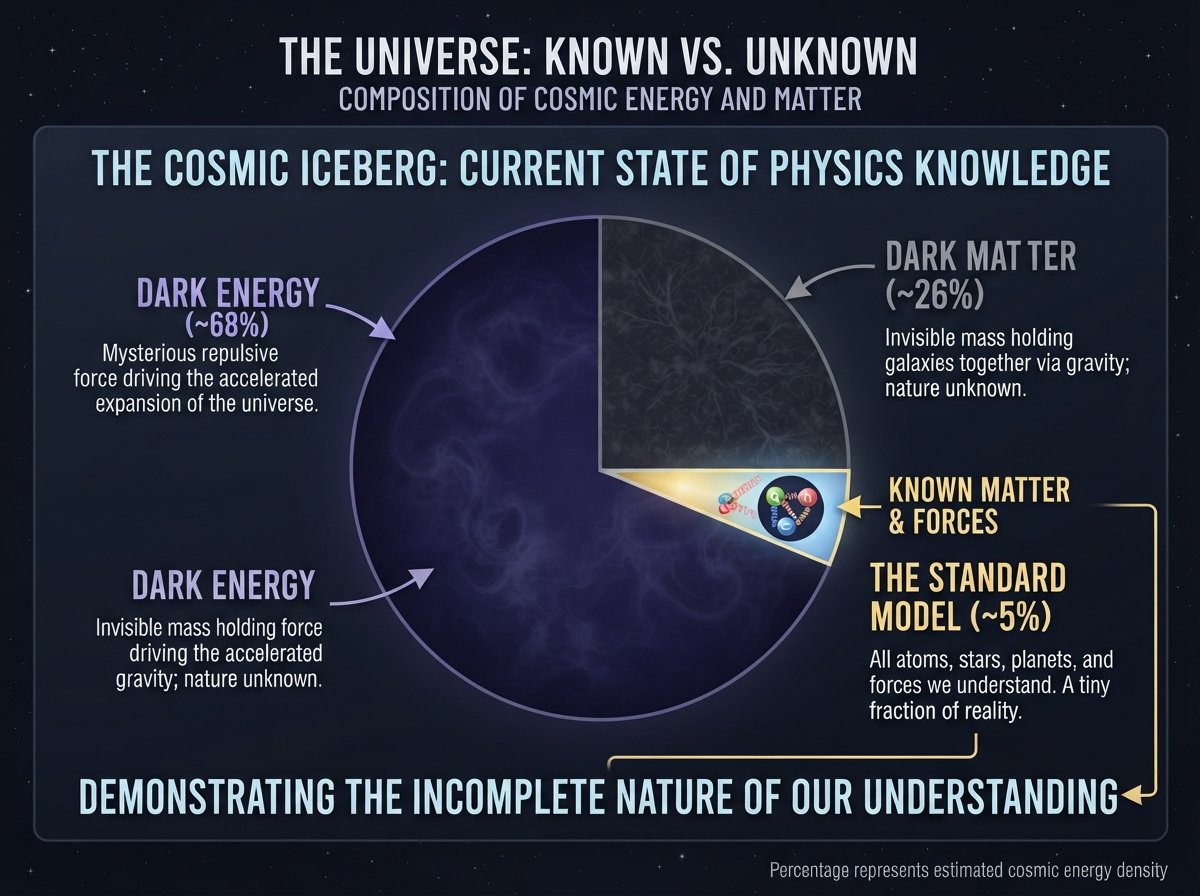
The mathematics behind these interactions also remains a Herculean challenge. Solving the exact equations for the strong force, as it occurs inside a proton, remains an unsolved mathematical problem today, requiring massive supercomputers to be simulated. The fundamental question of what sustains these fields themselves, or what exists before them, remains at the limit of human knowledge, marking the final frontier where our current theories meet their deepest limits.