AMD breaks world overclocking record with the Radeon RX 9060 XT
Por Arthur Bittencourt ·
New historical performance record
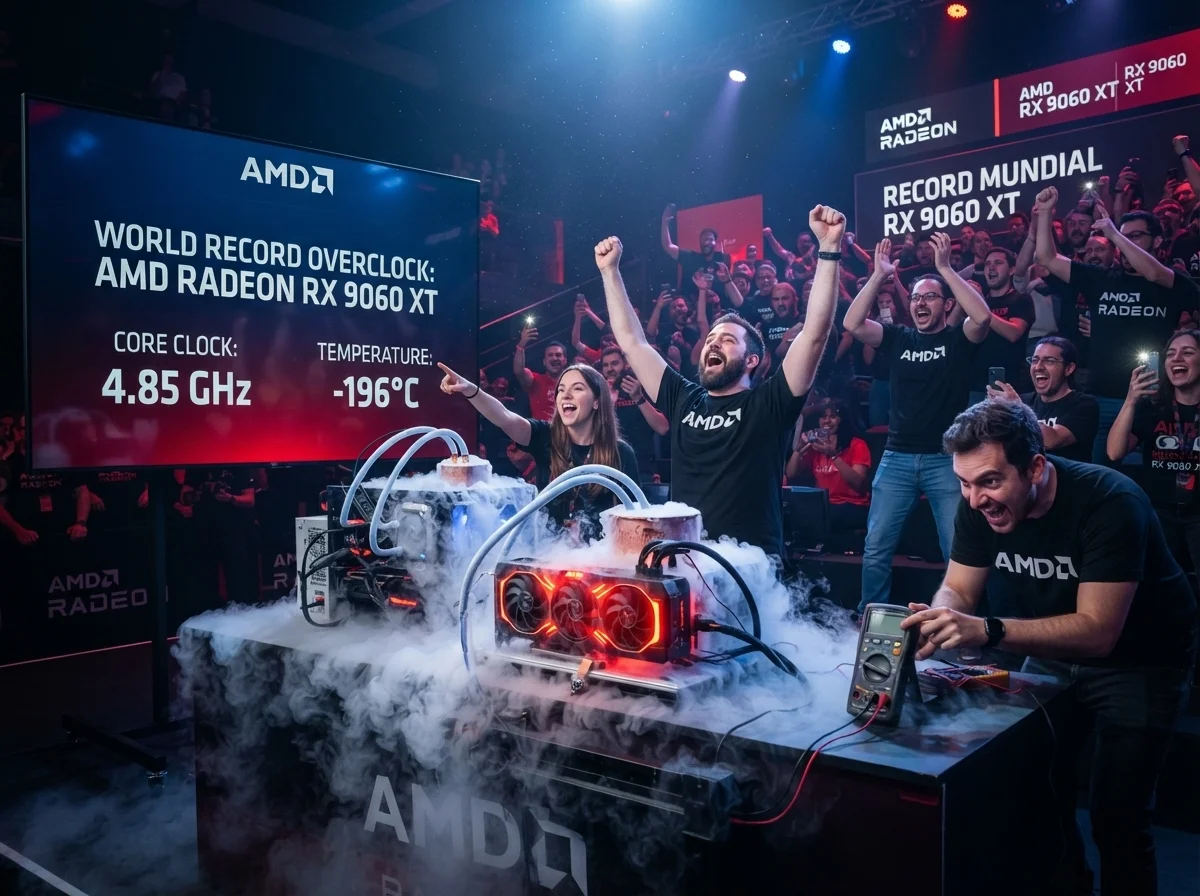
The manufacturer AMD officially registered a new world overclocking record for the Radeon RX 9060 XT model, reaching the impressive mark of 4,837 MHz. The achievement occurred during an event held in the city of Austin and slightly surpassed the previous limit registered for this same component, which was 4,789 MHz. This type of test serves as an absolute stress test of the internal architecture of the chips produced by the company.
The term overclock refers to the act of forcing a processor or Graphics Processing Unit (GPU) to operate at frequencies higher than those originally defined by the factory design. It's like adjusting a car engine to spin far above the limit planned by engineers; it can run faster for a short period, but it requires extreme care to avoid permanent damage to the internal components due to excessive heat generation.
Technical context and architecture validation
To understand the magnitude of this result, it is necessary to analyze the base numbers: while the standard speed of this card in boost mode is only 3,130 MHz, the achieved record represented an increase of almost 54.5% over the original specification. This mark is now registered in the OC Museum, a platform that monitors extreme timings and global technical validity.
The operation was not executed in isolation by enthusiast users, but involved the direct participation of the AMD engineering team, led by executive Jack Huynh. The effort involved close collaboration with Bill Alverson, known in the technical scene as Sampson, one of the most respected names in the field of hardware fine-tuning. This direct support ensures that the test followed rigorous protocols of technical analysis and operational safety throughout the experiment.
Thermal mechanics and extreme cooling
Keeping a GPU operating at frequencies close to 5 GHz without causing immediate silicon degradation requires unconventional cooling methods. In the case of this historical record, the team used liquid nitrogen to keep temperatures under control. Imagine liquid nitrogen as an instant "super-freezing" system; it removes heat generated by electronic circuits much faster than any conventional fan or air cooler could.
Without this cryogenic cooling technology, the internal components would quickly overheat until reaching critical melting or electrical failure points. Therefore, this record is purely experimental and demonstrates the physical robustness of the internal layers of the Radeon RX 9060 XT against maximum clock speed pressure. It is evidence that the internal design supports high data density even when pushed to the absolute limit by the tuning software.
Practical impact and limitations for users
Although this is a relevant achievement for AMD's technological prestige and hardware engineering, this performance is not available—nor should it be—for the average consumer in daily use. A home user cannot replicate these numbers without extremely expensive professional cooling equipment and dangerous procedures. The risk of permanent damage from overheating in conventional systems would make such an attempt unfeasible in most real-world scenarios.
Therefore, the news should be interpreted as a technological validation milestone: it proves that the current architecture has significant internal headroom, but it does not change the direct sales specifications to customers. There is no immediate practical change in expected performance during gaming or productive tasks; it is merely a theoretical ceiling reached by the brand to demonstrate technical superiority against global competition.