Discovery of the most distant and OLDEST quasar ever recorded by astronomy
Por Henrique Duarte ·
A new milestone in the universe's timeline
Science has reached a new level by identifying the most distant object ever observed in the cosmos. It is a quasar whose detection allows researchers to look back at an extremely primitive era in the history of our universe.
This discovery is fundamental because it transports us to a period when the universe was only six hundred and thirty million years old. This record opens doors to understanding how the first structures organized themselves shortly after the beginning of everything.
The record broken by the Euclid mission
The identification of this object was possible thanks to a collaborative effort involving various powerful instruments, including the Hubble, James Webb, Keck, and the Large Binocular Telescope (LBT) telescopes. The Euclid mission from the European Space Agency played a leading role in this process.
Interestingly, the Euclid mission itself surpassed its previous record by detecting this specific target. The object exhibits a "redshift" or z-value greater than eight point one three, which places it among the earliest records in this extremely remote category.
The engine behind the distant lights
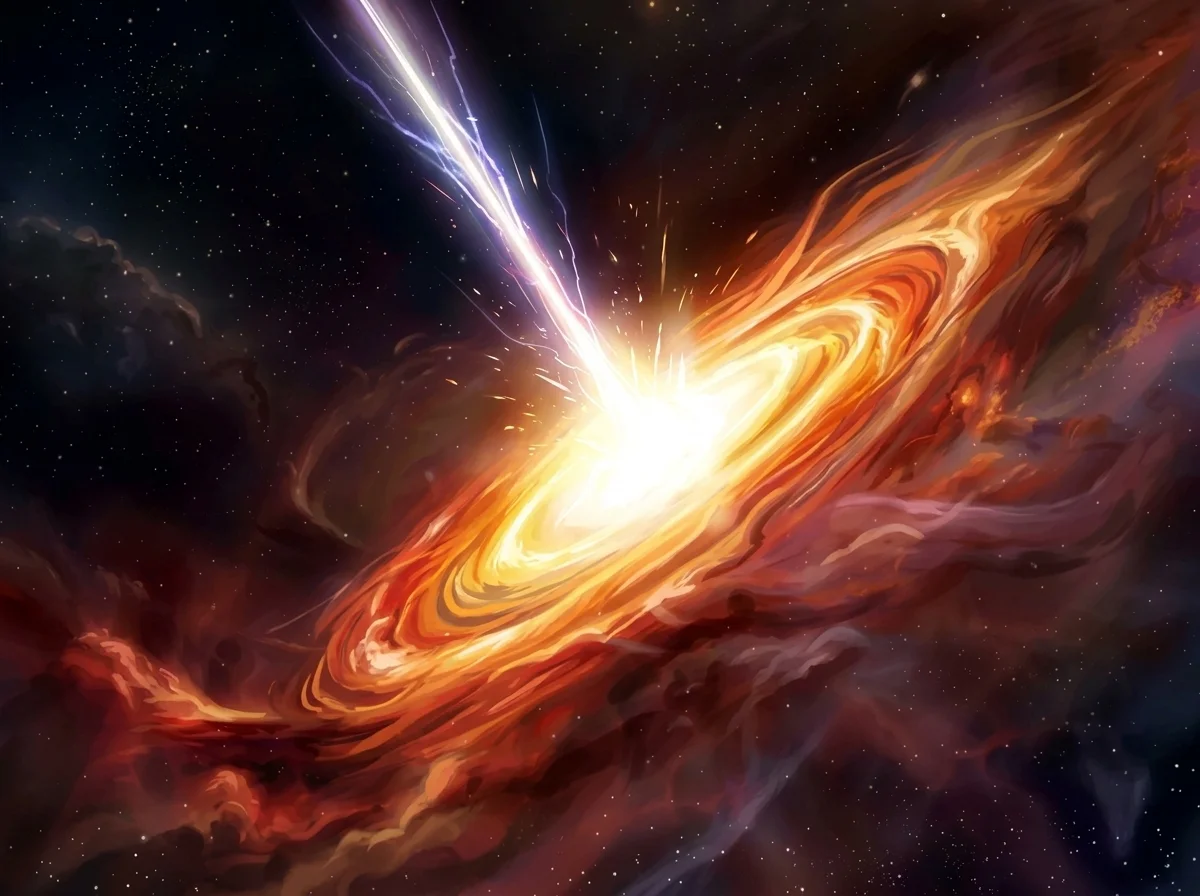
To understand this discovery, you need to understand what defines a quasar. It is part of a group of objects known as Active Galactic Nuclei. Simply put, imagine a giant star not as something static, but as an incredibly powerful and turbulent energy engine.
These engines are, in fact, supermassive black holes that are voraciously consuming matter. This material does not fall immediately into the center; it organizes itself into an accretion disk around the black hole. It is like a whirlpool spinning at extreme speed, heating up due to friction until it emits light and powerful energy jets.
A colossal mass in record time
The great mystery that intrigues scientists involves the proportion of this phenomenon's mass. The discovered quasar has about three hundred and sixty million times the mass of the Sun, even while being in such an early phase of cosmic evolution.
The central question is how an object of this magnitude managed to accumulate so much mass in such a short time. At the beginning of the universe, things should have only been starting to gain structure, which makes this early "giant" a challenge for current theories on gravitational growth.
Breaking the known physical limits
One of the hypotheses studied is whether this black hole fed above the Eddington limit. This limit acts as a kind of physical safety "cap": if a black hole tries to consume matter too quickly, the generated pressure and radiation can expel the material before it is consumed.
In this specific case, researchers are investigating whether a process called super-Eddington occurred, where the object would have grown much faster than conventional models predict. However, current data does not fully confirm if this was the exact mechanism used by this giant.
Theories about gigantic primordial seeds
Another line of thought suggests that these objects were born with massive "seeds." Instead of starting small and growing gradually, they might have emerged from direct collapses of giant stars or through the formation of primordial black holes from dense gas clouds.
If the initial seeds were large enough, they could achieve monumental sizes in very short periods of time. Science seeks to understand which of these two paths—extreme accelerated growth or early birth with large mass—best explains this phenomenon observed at the beginning of cosmic history.
The importance of building statistical data
To date, the number of active galactic nuclei discovered in the reionization era is extremely small, counting only about seven known examples. To create a robust scientific model, astronomy needs to deal with larger numbers to establish reliable statistics.
The more data we have, the better we can model how these structures formed. It is necessary to observe many similar cases before concluding any theory about the physical processes that governed the primordial universe.
Technological collaboration between telescopes
The success of this detection depends on the combination of different technologies working together. Besides Euclid and James Webb, other observatories play crucial roles in filling specific gaps in the collection of spatial information.
New missions, such as those involving Nancy Grace Roman and Vera Rubin, also promise to enter this equation. Each instrument offers a different "lens" to examine the past, allowing scientists to assemble a complex puzzle about the origin of the cosmos's first colossal masses.
The questions that arise at the beginning of history
Research into the beginning of the universe functions like an infinite search: the further we advance technologically and look back, the more discoveries generate new questions. With every new record broken, an even greater mystery emerges that needs to be deciphered with new tools.
At this time, the discovery of the quasar at z equals eight point one three remains one of the greatest current technical challenges. It makes clear that our understanding of the formation of the first giant structures is still under construction and awaits additional data from future space missions.