Two proofs of the Riemann hypothesis emerge simultaneously between humans and AI
Por Rafa Quintela ·
The announcement of simultaneous solutions
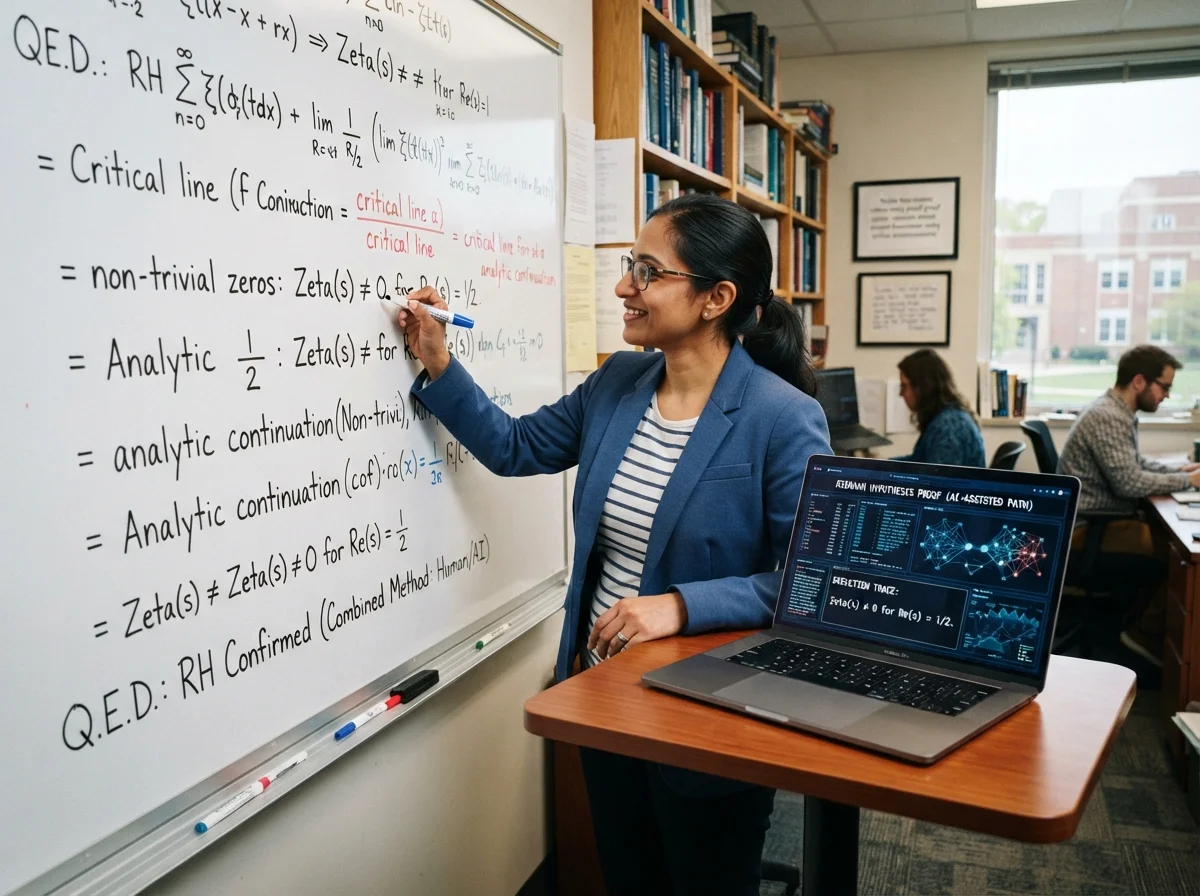
Mathematics took a monumental leap this week with the announcement of potential solutions to the Riemann Hypothesis. This is a problem that has remained unsolved since the mid-19th century, challenging brilliant minds for over 160 years. The most striking part of this news isn't just the potential resolution of the enigma, but how the answers emerged: two researchers presented their respective proofs almost simultaneously.
On one side, a proof was generated using artificial intelligence tools developed by Anthropic. On the other, a mathematics professor from Stanford presented a purely human resolution. Both solutions are still undergoing rigorous technical analysis, a process known as peer review, where other specialists validate if every line of mathematical reasoning is correct and free of logical flaws before they are officially accepted by the academic world.
Historical Context and the Millennium Prize
The importance of this milestone lies in the prestige of the hypothesis itself. It is part of the so-called Millennium Problems, a short list of mathematical challenges so complex that the Clay Mathematics Institute offers a A importância desse marco reside no prestígio da própria hipótese. Ela faz parte dos chamados Problemas do Milênio, uma lista curta de desafios matemáticos tão complexos que o Instituto Clay de Matemática oferece um prêmio de 1 milhão de dólares para quem conseguir resolvê-los. A hipossese de Riemann é considerada um dos pilares fundamentais desta lista, junto com problemas sobre equações diferenciais e computação complexa. million prize to anyone who can solve them. The Riemann Hypothesis is considered one of the fundamental pillars of this list, along with problems concerning differential equations and complex computation.
To understand the historical relevance, we can look at previous achievements. The Poincaré Conjecture, another Millennium Problem, was only solved in 2002, but the winner refused the money for personal reasons. Fermat's Last Theorem took centuries to be proven and was finally solved in 1993. The Riemann Hypothesis occupies this same level of extreme difficulty; solving it is not just a theoretical exercise, but a deep validation of the basic rules that govern numbers.
How does the mathematical logic behind the puzzle work?
In simplified technical terms, the problem revolves around Euler's Zeta Function. Imagine this function as a mathematical map where certain inputs produce specific results. The goal of this function is to help understand the distribution of prime numbers—those numbers that can only be divided by themselves and by unity, acting as the basic building blocks of all modern arithmetic.
The hypothesis states that all the non-trivial zeros of this function are located exactly on a specific line in the complex plane. To visualize this, think about the search for patterns: if these zeros are organized on this central line, it means there is an intrinsic and predictable order in how prime numbers appear in the infinite sequence of natural numbers. Proving this mathematically confirms that there is a solid and consistent structure hidden behind something that seems random at first glance.
Practical implications for digital security and science
A common question pops up when hearing about this kind of discovery: will it crack current passwords or compromise bank encryption? The short answer is no. While our digital security heavily relies on the difficulty of factoring large prime numbers, the proof of the Riemann Hypothesis only validates the mathematical logic of those numbers; it does not provide a "master key" to break them instantly. The immediate impact is more theoretical than operational for the average user.
However, the real benefit lies in the technological advances derived from the solution process. Just as the technology required to send humans to the Moon generated secondary innovations that changed lives, the new mathematical tools developed to prove this hypothesis could open doors to discoveries in various fields. Solving a problem of this magnitude expands our computational and theoretical capabilities, creating resources for new artificial intelligence models and much more efficient data processing methods in the future.
Limitations and the Role of Machines in the Process
It is important to note that we do not yet have a definitive conclusion. Like any major scientific breakthrough, these findings must pass the scrutiny of the global community before they can be declared true. Furthermore, collaboration with AI introduces a new challenge: verifying whether the machine followed a valid logical path or if it merely ran a high statistical probability without understanding the underlying mathematical foundation.
Using Anthropic's "Lin" tool exemplifies this new frontier, where the complexity is so high that even experts struggle to verify every step manually. AI steps in here by accelerating calculations and organizing massive structures, but the final validation still relies on human judgment. We are witnessing a transition where mathematicians can focus less on the exhaustive execution of formulas and more on proposing original new hypotheses.
Humans vs. Technology: A Comparison and the Road Ahead
This scenario reminds us of classic historical showdowns, like when computers surpassed humans at chess. Initially, individual talent was unbeatable; today, machines process possibilities on a scale impossible for any human mind. In advanced mathematics, we are seeing this watershed moment unfold right now. The existence of two simultaneous proofs suggests that science is reaching a point of technological saturation where different paths—organic and synthetic—can arrive at the same absolute truth simultaneously.
In the long run, the question isn't who will win the race to solve the problem, but rather how these solutions will shape the next decade of scientific advances. We must closely observe the results of peer reviews in the coming months. For now, the recommendation is to track the progress of the technical tests before assuming any immediate changes to global security or cryptography practices.