Enthusiast keeps RTX 5090 at minimum temperature with extreme cooling system
Por Arthur Bittencourt ·
Record thermal performance in synthetic test
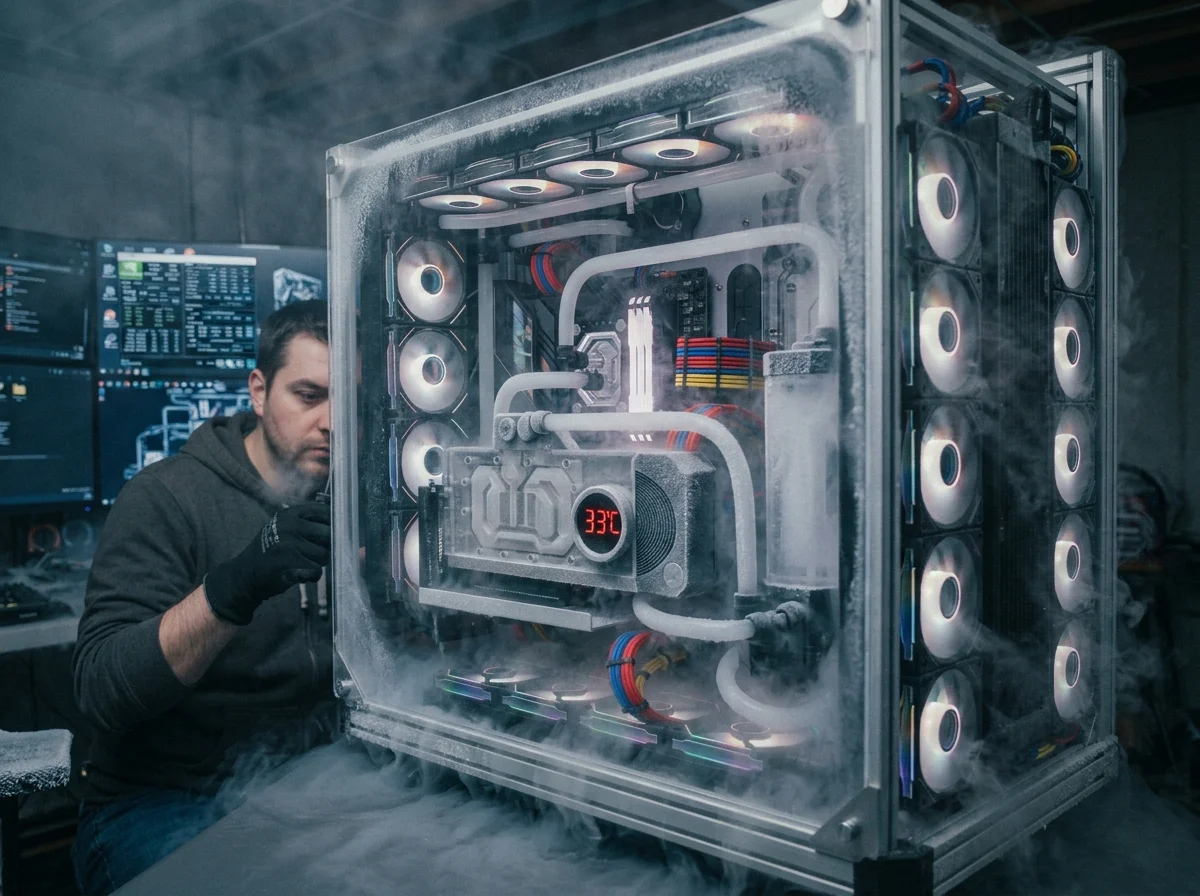
Heat management has become one of the biggest obstacles to the development of increasingly powerful graphics cards, but a recent experiment showed the extreme limits of this engineering. An enthusiast achieved impressive results with an NVIDIA GeForce RTX 5090, managing to keep it operating under maximum load at extremely low temperatures. During the use of the 3DMark Steel Nomad software, the card registered an average of approximately 33°C while delivering nearly fifteen thousand points in the test.
The secret to this result was not in software adjustments, such as overclocking—which increases GPU frequencies to gain performance—or undervolting, a technique used to reduce power consumption without sacrificing much performance. Instead, the focus was purely on the physical cooling infrastructure. The system utilized a robust setup composed of the GIGABYTE AORUS RTX 5090 XTREME WATERFORCE AIO installed inside a Corsair 7000D Airflow case, creating an environment where the airflow is constant and massive.
Why extreme cooling matters now
The importance of keeping components cold lies in the stability and longevity of the semiconductors. When a GPU reaches high thermal limits, it can suffer from "thermal throttling," a safety mechanism where the chip intentionally reduces its speed to prevent physical damage from excessive heat. This phenomenon acts like an automatic thermostat: if the temperature rises too much, the component "slows down" to cool off, directly harming the player's frames per second (FPS) during intense sessions.
With the arrival of new architectures and GDDR7 memory, the heat density in small areas of the card has increased significantly. This means that manufacturers need to remove thermal energy more efficiently before it accumulates in critical components. Keeping these parts below critical temperatures ensures that they operate at the ideal electrical operating point, allowing the hardware to sustain high frequencies without sudden performance fluctuations over time.
System dynamics and PWM technology
To achieve this level of cooling, the user organized thirty fans using stackable magnetic supports and PWM controllers. The term PWM refers to Pulse Width Modulation, an electronic method of power control. Imagine a faucet that, instead of just being fully open or fully closed, can precisely adjust the water pressure; PWM does this with the electricity sent to the fan motors, allowing them to spin at specific speeds based on the actual airflow need at that exact moment.
This configuration created a constant airflow path around the All-in-One (AIO) liquid cooling system, ensuring that the heat extracted by the radiator did not accumulate inside the case. Furthermore, the technical complexity was visible in the cable management. To handle the dozens of wires generated by the extra fans, the enthusiast used colored labels behind the motherboard, facilitating organization and allowing for individual maintenance of any component without needing to dismantle the entire internal structure of the computer.
Practical impact for the end consumer
Although the presented numbers are impressive—such as achieving 39,718 points in the conventional Time Spy with an average of 32°C—it is necessary to analyze how much this build changes the real-world experience. The data indicates that this setup maintained results approximately 6.87% above the average recorded by other RTX 5090s. This suggests that while extreme cooling helps ensure maximum stability and longevity, the direct gain in frames per second may be marginal compared to the logistical effort required to build such a machine.
For the average user, this experiment serves more as a technological ceiling than a practical recommendation. Most modern GPUs already have cooling systems efficient enough to maintain acceptable temperatures under normal load. The use of thirty fans is a niche solution, aimed at those who seek to push hardware to the absolute limit of thermal efficiency or who want to display an exaggerated aesthetic based on airflow engineering.
Limitations and risks of the extreme configuration
An important point to consider is the law of diminishing returns: adding each new fan brings progressively smaller benefits until the system reaches a state of thermal saturation. Furthermore, there are significant indirect costs. Each additional fan consumes its own electricity and generates noise, in addition to occupying precious space in the case. If the performance difference between a good three-fan system and this army of thirty is small, the extra complexity may not justify the investment in time and additional components.
Another relevant technical factor was observed in the GDDR7 memory, which reached a maximum of 49°C during testing. Although this is well below the critical limit, it shows that even with this massive cooling, certain parts of the board still concentrate heat due to their physical proximity to the memory modules. This reinforces that technology is advancing to levels where simply "blowing more air" may not be sufficient if the PCB (Printed Circuit Board) design is not optimized simultaneously.
Comparison and future perspectives
When comparing this experiment to standard market configurations, it is clear that the RTX 5090 has a robust thermal margin when powered by adequate solutions. The average of the other cards tested by Wccftech serves as an important baseline: they function perfectly without needing such drastic measures. This specific case is a proof of concept regarding how far we can push passive and active dissipation to keep modern chips operating almost cold under severe stress.
For those planning to invest in high-performance hardware today, the lesson is clear: a good case with decent airflow already does a lot for the system. However, for enthusiasts seeking to set records or maximize every fraction of a percentage point of stability, the extreme engineering offered by such systems continues to be the final horizon of thermal tuning in personal computing