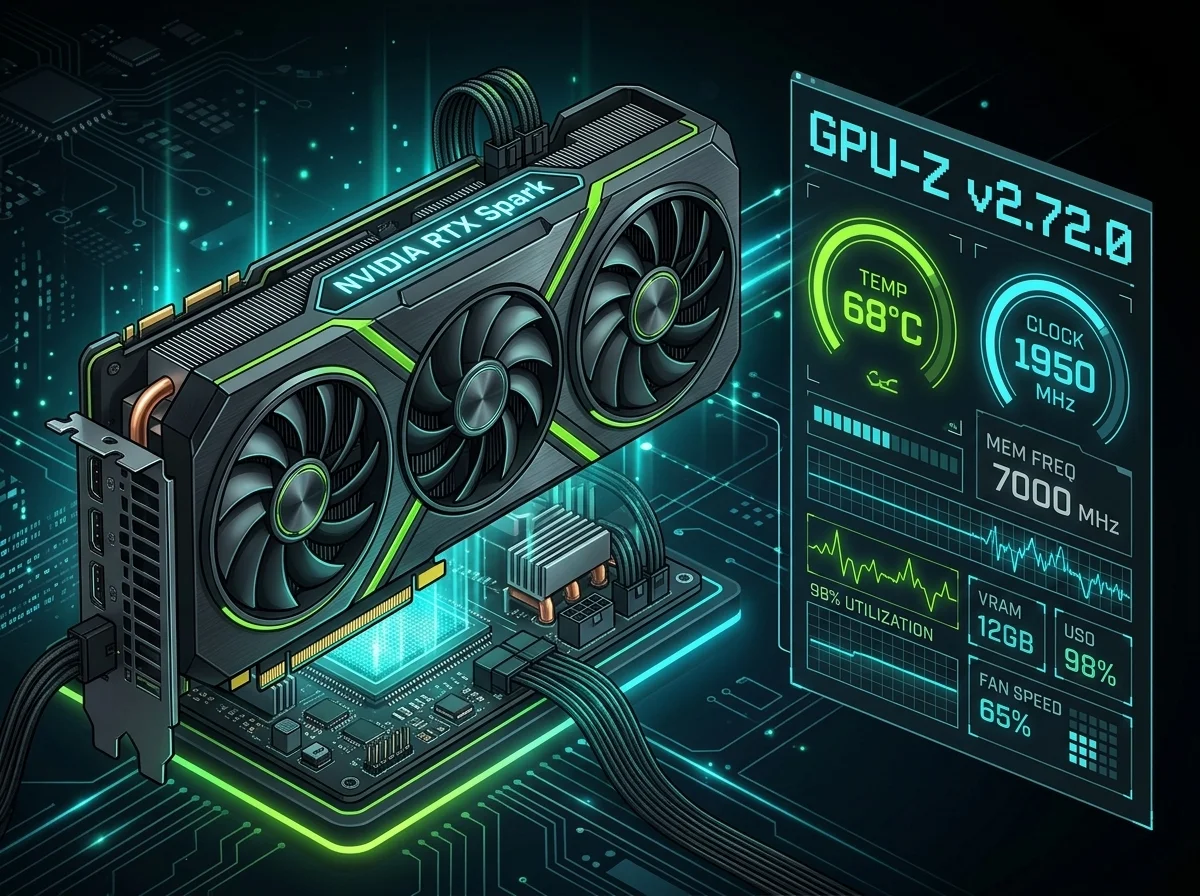
GPU-Z v2.72.0 gains support for the new NVIDIA RTX Spark
Por Arthur Bittencourt ·
Extended hardware and new component support
The GPU-Z diagnostic tool has received version 2.72.0, bringing an extensive list of new compatibilities for enthusiasts and tech infrastructure professionals. The most significant update is the official support for the new NVIDIA RTX Spark line, designed specifically for local artificial intelligence (AI) inference. Furthermore, the utility now monitors various AMD components, including specific iGPUs, mining GPUs like the BC-250, and models from the Radeon R9 up to RX 500 series. The goal of these inclusions is to ensure that users can obtain accurate data on chips that are just beginning to circulate in the market.
The role of RTX Spark in modern architecture
To understand why this component requires special attention, you need to grasp the concept of local inference. Imagine you want to process a complex command on a personal computer without sending the data to an external server; this requires raw processing power within the machine itself. RTX Spark meets this demand by utilizing 20 cores based on the Grace architecture and integrating 6,144 CUDA cores based on Blackwell technology. The CUDA cores function like specialized workers: each unit simultaneously executes simple mathematical calculations to perform heavy graphical or mathematical tasks with extreme speed.
Technical improvements and sensor usability
The update is not limited to adding new names to the compatibility list, but also brings important structural refinements for those who rely on reliable thermal data. For example, the software corrected the nomenclature of hotspot sensors, ensuring that both AMD and NVIDIA cards correctly display their critical internal temperature points. This prevents misinterpretations during stress tests, where the difference between general heat and a specific zone can indicate serious cooling problems in the system. Additionally, a simplified visual feature has been included that reveals statistics when hovering the mouse over specific values.
Initial limitations and graphical stability
While the integration with the new NVIDIA hardware is functional, there are inherent limitations in preliminary releases. Currently, detailed specifications regarding the RTX Spark memory are still absent, and we expect this information to be added in subsequent updates as the drivers mature. Another key point is the correction of OpenGL detection errors—a crucial standard that ensures graphic software correctly recognizes the capabilities of the installed video card. These minor improvements are essential to ensure that users do not encounter diagnostic failures in complex gaming or professional environments