Warp drive and the limits of Einstein's equations
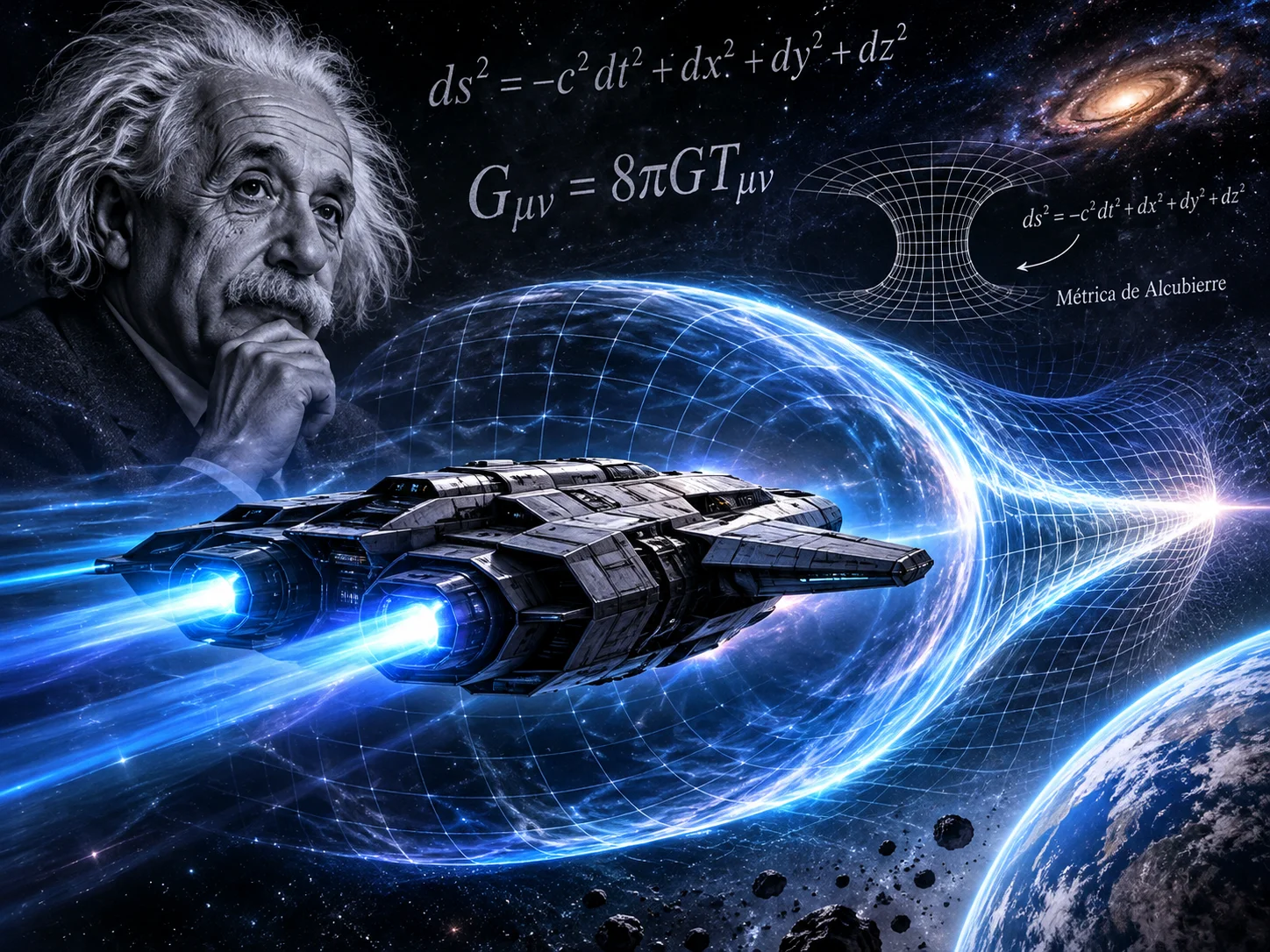
Por Arthur Bittencourt ·
The mathematical concept of the warp drive
In 1994, Miguel Alcubierre proposed a theoretical solution to surpass the speed of light limit without directly violating general relativity. Instead of accelerating an object through space at a speed faster than light—something locally prohibited—the proposal suggests manipulating the fabric of the universe itself.
In the proposed model, the ship would be inside a bubble where space expands behind it and contracts in front of it. To understand this dynamic, think of the expansion of the universe like a raisin bread baking: the raisins don't "run," they are pushed away because the surrounding mass grows. In this scenario, the ship would remain static in its internal reference frame, while the curvature of spacetime moves its position.
It is a fundamental change of perspective: it is not the vehicle that gains excessive speed, but the spatial geometry around it that undergoes deformation. Therefore, theoretically, it would be possible to arrive before a light signal, since the displacement occurs through the structure of the vacuum and not through conventional mechanical movement.
The barrier of exotic negative energy
Einstein's equations allow this architecture, but they require a problematic ingredient: negative energy density. While common matter has positive energy (like stars or atoms), negative energy would be composed of substances with less weight than nothing—something outside of the patterns observed so far.
Alcubierre identified that to create such a distortion, exotic materials would be needed—substances that have never been directly measured by science. The problem escalated when physicists calculated the quantitative requirements of this "matter." Initial models suggested that a 100-meter bubble would require about $6 \times 10^{62}$ kg of negative energy—a quantity ten billion times greater than the entire mass of the observable universe.
Although later research has tried to reduce this number through complex geometries and tiny spatial "pockets" on the outside and large on the inside, the need for exotic material remains the main theoretical impediment. Without a proven source of sustainable negative energy, the required engineering remains in the realm of pure speculation.
Operational obstacles and thermal risks
Even if we had the necessary matter, there are severe fundamental physics challenges. One of the main ones is causal disconnection: the front boundary of the bubble moves so fast that no signal from the ship can reach it to control it. This means the crew would not be able to brake or steer the structure; they would only be following a process initiated previously.
Furthermore, there are extreme environmental dangers associated with space manipulation. Calculations indicate that the bubble walls could generate Hawking radiation, raising the internal temperature to levels near the Planck scale—trillions of degrees Celsius—evaporating any passenger instantly. Another risk lies in the accumulation of interstellar particles at the front of the bubble, which would be compressed and released as lethal beams of gamma rays upon reaching the final destination.
The current state of scientific research
Currently, the focus has shifted from the viability of superluminal travel to more realistic subluminal models. Recent research suggests that a solid spatial shell could create a functional bubble below the speed of light using common positive energy. However, even in these variants, the propulsion challenge remains without a clear solution, as the shell would require a powerful external engine to be pushed.
In 2024, simulations showed that these structures can collapse and emit gravitational waves detectable by terrestrial observatories. This opens a new frontier: before building real warp engines, perhaps we can first detect the traces of these spatial distortions being tested or occurring naturally. For now, the warp drive remains a solid mathematical concept with physical barriers that are almost insurmountable with today's known technology.