New AMD technique aims to reduce the burden of ray tracing on GPUs
Por Arthur Bittencourt ·
Launch of the RT-MLAS technology
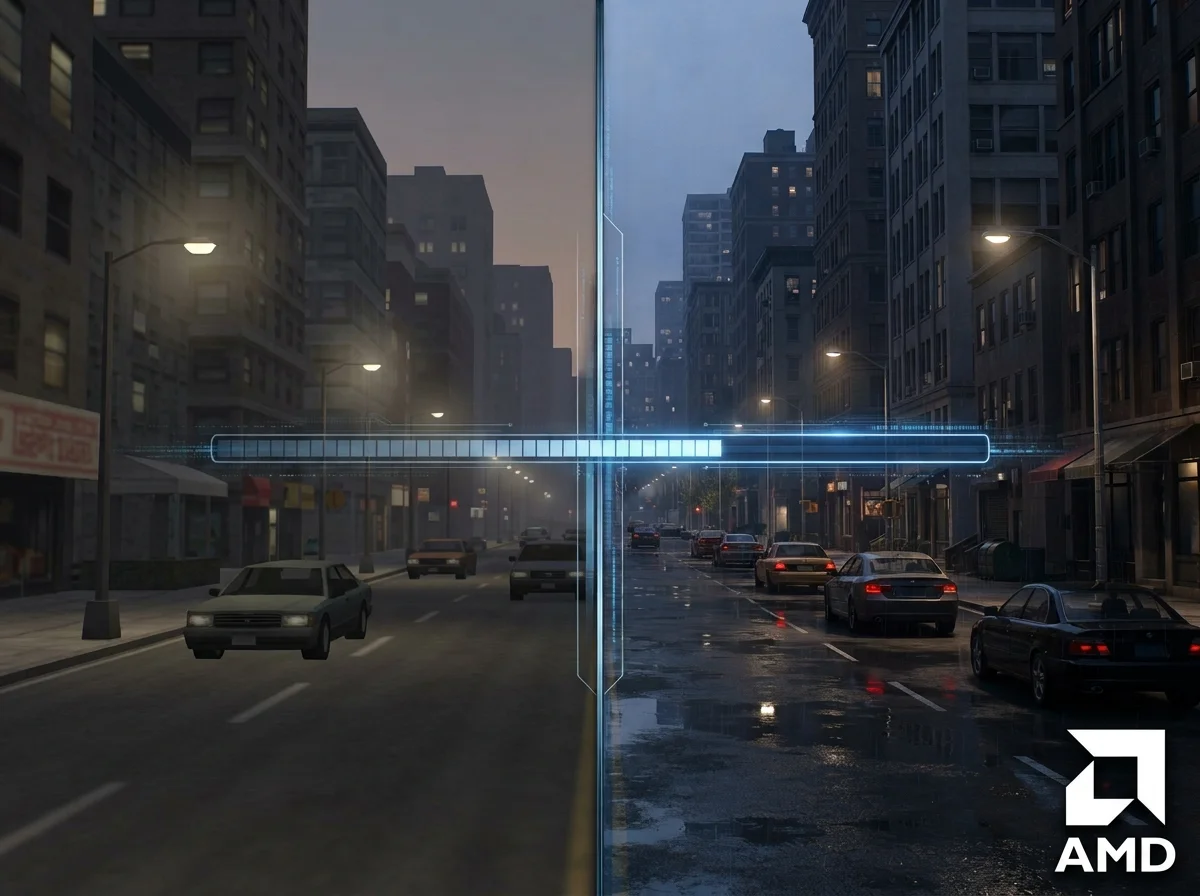
AMD recently introduced a new approach to handle large-scale ray tracing within dynamic environments. The main focus is to increase process efficiency, allowing graphics cards to process thousands of objects simultaneously without drastically compromising system resources.
This innovation was presented during a graphics programming conference in the Netherlands, where the manufacturer demonstrated its ability to handle extremely dense scenarios. The central proposal revolves around Ray Tracing Multi-Level Acceleration Structures (RT-MLAS), a method designed to alleviate the historical bottlenecks of this graphics technology.
How the new acceleration system works
To understand this change, you need to understand acceleration structures, which function like "maps" that help light rays navigate a game's geometry. Traditionally, these maps are divided between static data and moving instances, but this model struggles when many objects move at the same time on the screen.
The key difference of RT-MLAS is the inclusion of a third intermediate level in these structures. This layer allows developers to define parts of the lighting calculations as reusable. It's as if the GPU doesn't have to redraw the entire map every time a character walks; it just adjusts small details in already pre-calculated areas.
In practice, this means grouping similar materials, such as windows or roofs. In a complex scene, an entire building facade composed of identical items no longer needs to be recalculated entirely every time the camera changes position. This saves memory bandwidth and reduces the effort required to update these structures in mutable scenes.
Performance observed in tests
During the technical presentation, AMD proved the effectiveness of this optimization by running over 40,000 independent animated objects with primary and shadow rays active. The result was impressive: the system maintained a constant frame rate of 60 frames per second at Full HD resolution using an RX 9070 XT.
This advancement puts the red manufacturer in a strategic position against direct competition. Although it historically lagged behind NVIDIA in realistic lighting, the new advances suggest that this gap is rapidly closing. The technology aims to make this feature accessible not only to flagship GPUs, but also to users with mid-range hardware.
Availability and impact for developers
The good news is that this tool is already integrated into GPUs based on the RDNA 4 architecture. This means that game developers can immediately start implementing these efficiency gains in their upcoming titles, focusing on improving visual quality without sacrificing much hardware performance.
For those looking for a balance between cost and technological performance, these improvements are fundamental. By significantly reducing ray tracing overhead, AMD offers a path to democratize more complex scenarios in modern video games, ensuring smooth gameplay even in situations with high object density in the scene.