New CPU benchmark aims to compare processors spanning four decades

Por Arthur Bittencourt ·
The launch of CrystalMark CPUix
Noriyuki Miyazaki, the developer behind the famous CrystalDiskMark tool, is working on the CrystalMark CPUix project. The central goal of this new application is to establish a scoring system that allows for a direct comparison between different generations of microprocessors over the last forty years.
The goal is for users to visualize technological progress by placing historical components, such as the 1985 Intel i386, side-by-side with contemporary AMD or Intel architectures. The official debut of this new measurement instrument is scheduled for March 2027.
To ensure this historical scope, the software was designed to operate on classic operating systems, including Windows 95 and NT 3.51. This compatibility allows the benchmark to run on machines whose technical specifications would today be considered rudimentary for modern software.
Technical architecture and functionality
One of the biggest technical challenges of this project is dealing with older processors that do not have an FPU (Floating Point Unit). To understand the analogy: imagine if you only had a calculator capable of adding integers, without being able to process decimal places; that is how some chips functioned before the 486DX standard.
CrystalMark CPUix will need to function correctly on these limited devices, something that almost no modern benchmark attempts due to current complex instruction requirements. The developer seeks to find a technical balance to validate both the simplest chips and modern CPUs without unfairly favoring any specific architecture.
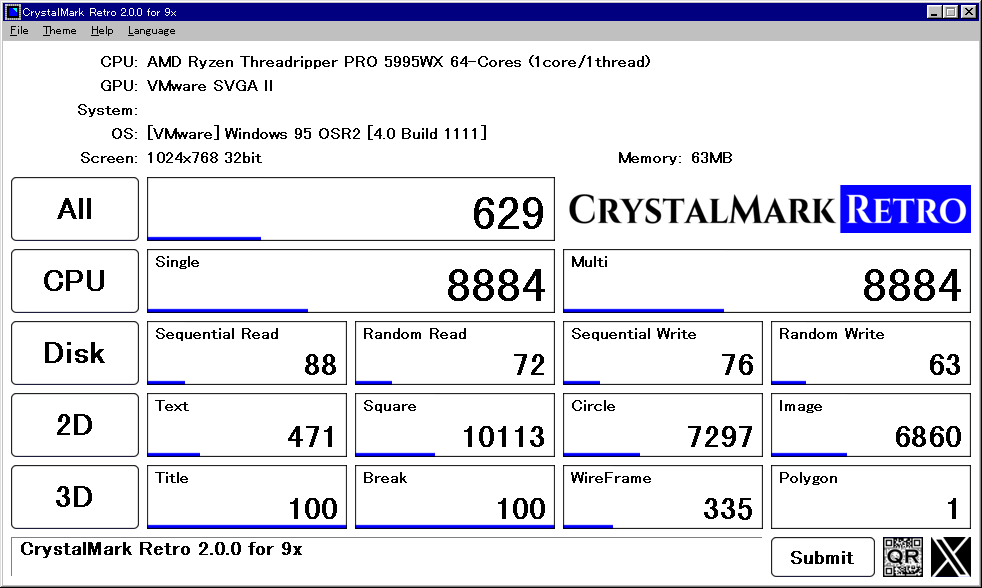
The scoring methodology serves as a comparative baseline. Miyazaki uses established references from its predecessor, CrystalMark Retro, where specific workloads are calibrated against powerful hardware, such as the Threadripper PRO 5995WX, generating proportional values for each core tested across the various evaluated models.
Practical impact and visual interface
Practically speaking, this tool offers computer enthusiasts and historians a single yardstick to measure the exponential leap in processing power over time. It fills a gap where traditional benchmarks fail because they cannot handle such old code or such simplified architectures.
To accommodate these old machines, the visual interface itself was designed with rigorous technical restrictions. The application must be capable of running on monitors with very low resolutions and limited color depths, while maintaining visual elements characteristic of the original project, such as specific color tones in the windows.
Historical context and perspectives
The development of this software is deeply linked to Miyazaki's career. After completing nearly three decades with CrystalDiskMark—today one of the world's references for SSD testing—he now seeks to consolidate his legacy by applying that same methodological rigor to historical processor hardware.
Although the exact workloads have not yet been fully detailed publicly, the testing infrastructure already involves real hardware collected by the developer, including rare Japanese models. If the plans are executed as scheduled, CPUix will become a chronological milestone in computing in 2027.
If you are an enthusiast who values historical preservation or wants to understand exactly how far we have come in the evolution of chips, it is worth waiting for the official debut to get a definitive view of this technical journey backed by concrete numbers