New Chinese method accelerates Ray Tracing by up to 59%
Por Arthur Bittencourt ·
Technological breakthrough for graphic rendering
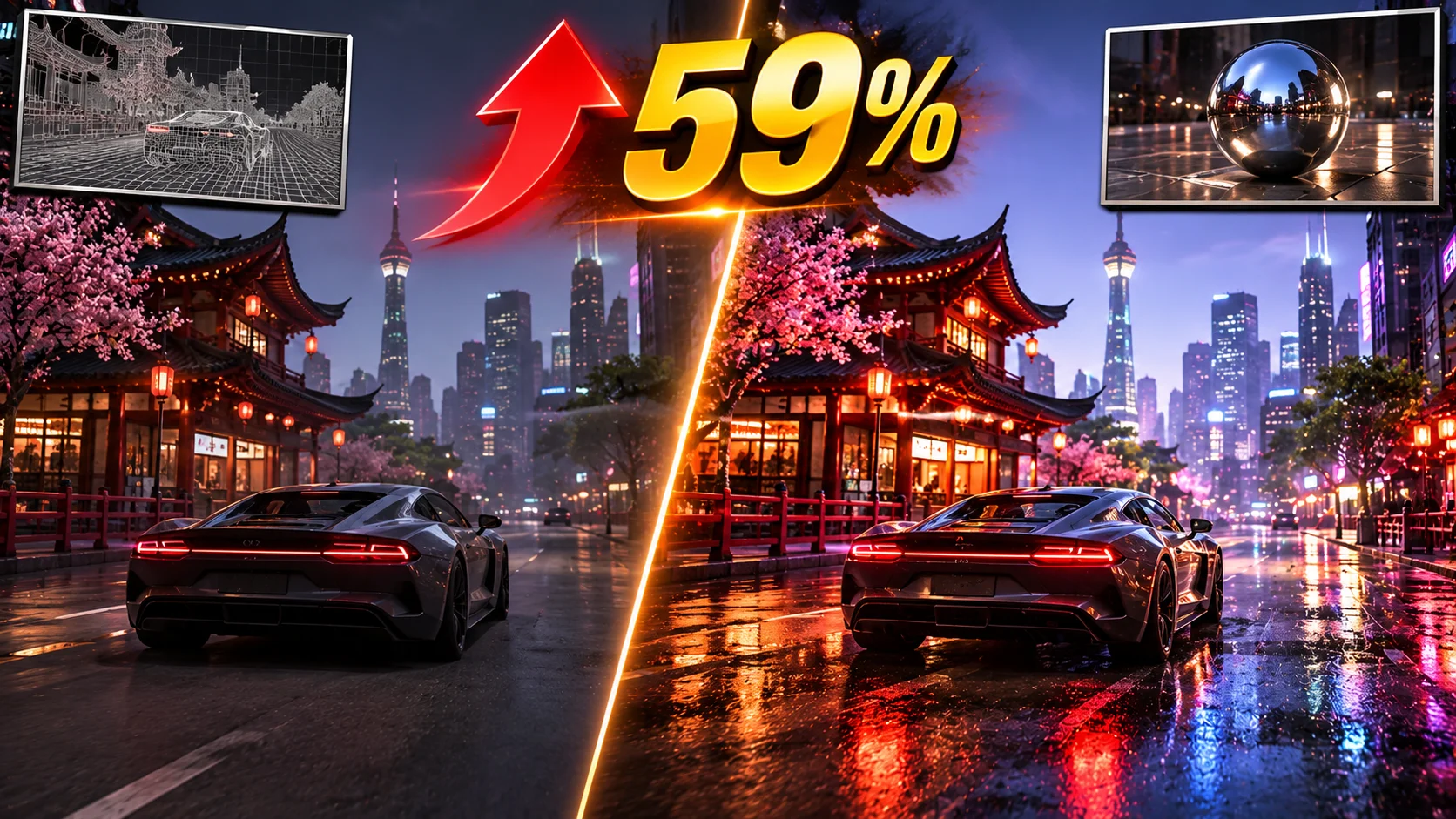
Researchers at Wuhan University, China, developed a new algorithm called BMA capable of significantly accelerating the Ray Tracing process. According to the study published in the scientific journal Computers, this technique can boost rendering speed by up to 59%, while consuming less than 1% additional memory. The main focus is reducing the time needed to calculate how light rays interact with complex objects in a scene.
The method specifically focuses on making the search within the BVH (Bounding Volume Hierarchy) structure more efficient. To understand better, imagine that a game scene is like a giant library: instead of checking every book individually, you first look at the general sections and only enter specific shelves when you know where you are looking. The BVH works exactly like this, dividing the game world into smaller volumes so that the computer doesn't have to test millions of triangles simultaneously for every emitted ray.
How the algorithm's intelligence saves processing power
The core insight of the BMA algorithm lies in the observation that neighboring pixels tend to generate very similar light rays because they are close in three-dimensional space. Technically, this means these rays will probably travel almost identical paths through the branches of the scene's data tree. It's like knowing the way to a friend's house; if your neighbor's house is close, you start your walk halfway through the journey, skipping the initially known streets.
By identifying this similarity, the system divides the image into small blocks and triggers calculations only starting from the central pixel. If there is more than a 90% chance that other rays will pass through the same nodes of the structure, they "skip" directly to that intermediate point, avoiding unnecessary repetitions. This strategy is applied to both light reflections and refractions, allowing the hardware to process complex information with less raw computational effort during rendering.
Performance measured in classic scenarios
During tests conducted using Intel's Embree library, the results were impressive. In the famous Sponza scene, for example, the number of search tree traversals was cut in half, reducing the total rendering time from about 187 seconds to just under 118 seconds. In other situations, such as the Dragon scenario, the acceleration was more modest, yet consistent, always maintaining a high visual fidelity represented by technical metrics above 35 dB (PSNR).
Efficiency varies depending on the complexity of the environment resulting from the present geometry. Very simple scenarios did not show significant gains because their structures are naturally shallow and do not offer many redundant paths to cut. However, for scenes densely populated with detailed objects, BMA proves to be a powerful tool. The impact on memory remains insignificant, varying by only about 1 MB depending on the configuration, which makes the solution highly viable for future commercial implementation.
Limitations and precision of the technique
Because it is a method based on probabilistic approximation, the algorithm may present small flaws in extremely thin objects or minuscule details. Items with dimensions smaller than 16 pixels on the screen, such as lamp wires or mug handles in certain compositions, may escape block analysis and not receive the correct optimization. This explains why some environments showed smaller speed gains when they were filled with these small decorative elements.
Although these errors are almost imperceptible to the human eye in most situations, they represent the current limit of the proposed technology. The trade-off between extreme speed and absolute perfection is small, but important for developers seeking extra milliseconds of performance in modern graphics engines. For now, the technique works best in wide scenarios where visual continuity predominates over isolated microscopic details of the graphic scene.