New port brings classic Silent Hill to PC with ray tracing and artificial intelligence
Por Juca Aranha ·
Modern graphics in an oppressive atmosphere
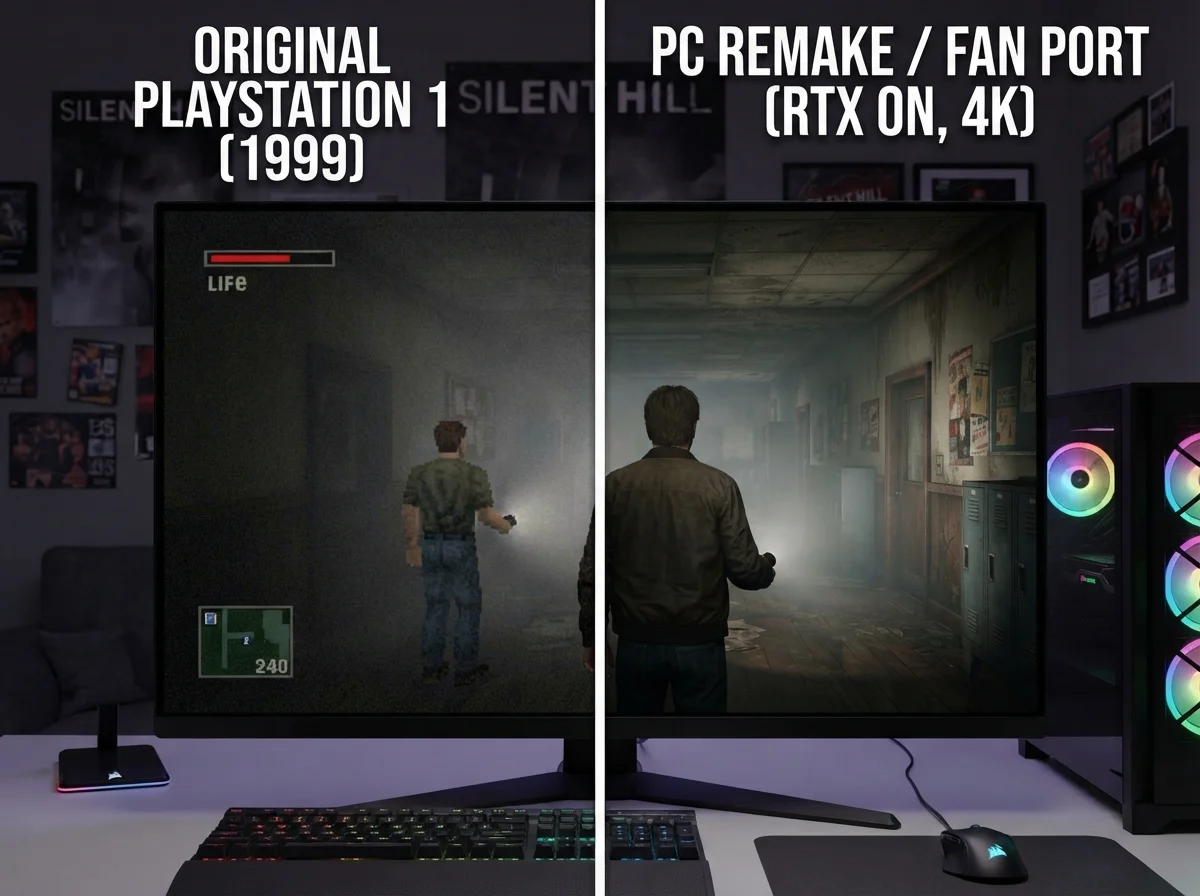
The new project titled Silent Hill PC aims to bring the visual experience of the 1999 title up to modern standards. The work focuses on faithfully recreating the fog, the darkness, and that heavy atmosphere that defines the franchise, while adding robust features like HDR and volumetric fog.
To improve sharpness, Real-ESRGAN technology was applied, capable of enlarging original textures up to four times using artificial intelligence. Players can switch between higher fidelity to the original version or Ultra RTX mode, which uses advanced reflections and indirect lighting via ray tracing.
Native performance and proprietary graphics engine
Unlike many community projects, this port does not use common emulators. It runs on a custom graphics engine written in C++20, offering support for Vulkan, SDL3 GPU, and OpenGL. This structure allows for rates above 60 FPS even during cinematic scenes and near-instantaneous loading.
The technical implementation is significant because it uses its own rendering logic instead of merely translating decompiled code with compatibility layers. This ensures that the game behaves smoothly on widescreen monitors without compromising the classic PC gameplay.
Deep customization via Lua scripts
One of the project's major focuses is the ease of creating modifications. The system features Lua-based scripts, allowing users to add new items, weapons, and events without having to directly edit the main files of the engine dedicated to the title.
To assist modders, tools such as free camera, map inspector, and model viewers are already integrated into the platform. This ecosystem facilitates the expansion of original content while maintaining the stability needed to run the game natively on Windows and Linux systems.
Technical requirements and availability
The source code is open on GitHub, but it does not include the game data itself due to legal issues. To run the updated version, the user needs to provide a specific disc image of the North American v1.1 (SLUS-007.07) edition of the PlayStation 1 originally released by Konami.