The progressive collapse of the Chernobyl radioactive core
Por Rafa Quintela ·
Damage to the containment infrastructure
In February 2025, an explosive-laden drone hit the roof of the New Safe Confinement in Chernobyl, causing a fire and opening a breach in the external cover. This colossal structure was designed to isolate the reactor for at least a hundred years.
Although firefighters quickly controlled the flames and inspectors from the International Atomic Energy Agency confirmed that external radiation did not rise—thanks to the old sarcophagus that still offers internal protection—the seal was compromised. Engineers are now working on a restoration plan that should last until 2030 to repair the damage caused by the perforation in the middle of a war zone.
The physics of internal degradation
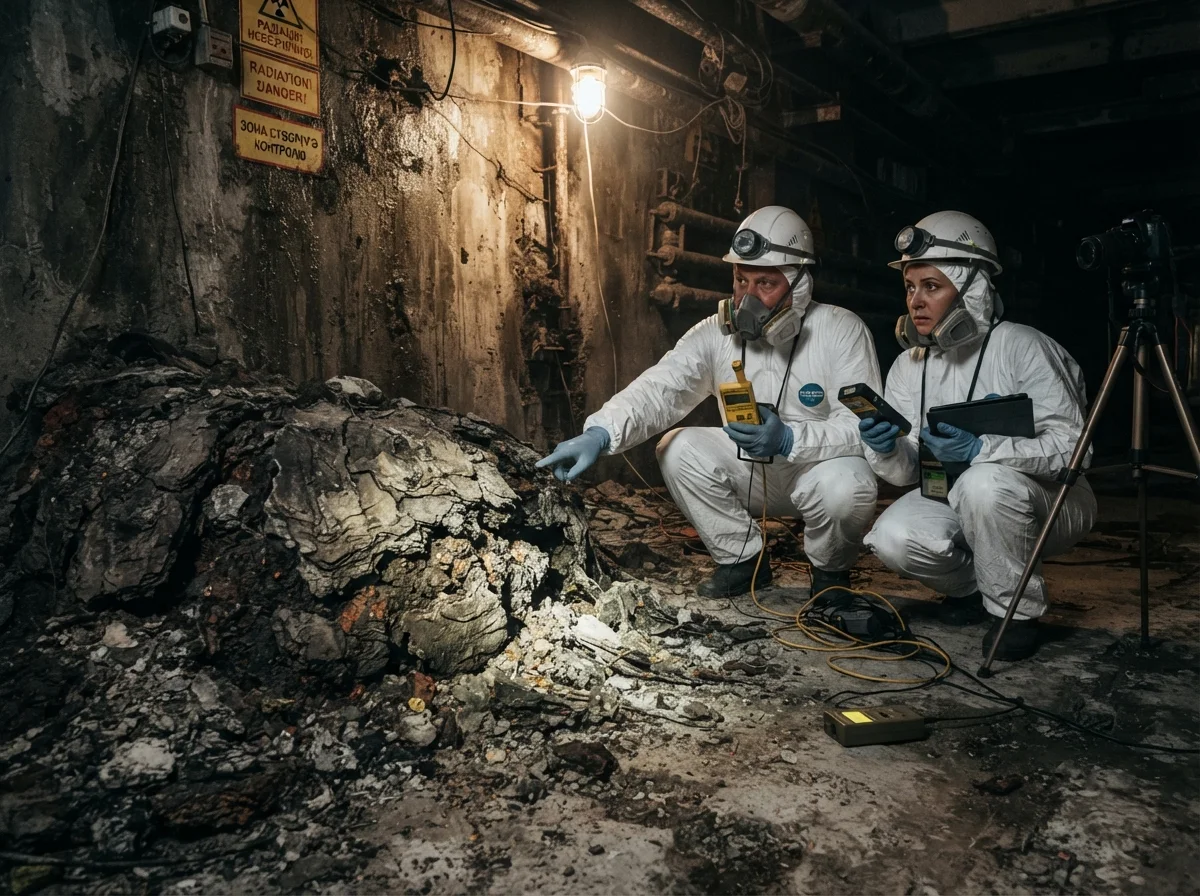
Below the ruins, an extremely radioactive formation called "Elephant Foot" is undergoing a worrying structural change: it is disintegrating. Originally solid as glass or iron, the mass suffers from the constant release of energy from decaying atoms, which generates continuous internal heat and weakens molecular bonds.
This process functions like material fatigue on a microscopic scale; each broken fragment pushes its neighbors, creating cracks that turn the rock into dust or coarse sand. Unlike a stationary solid block, this pulverization represents a much greater risk, as fine particles can be suspended in the air by wind currents or leaks, becoming lethal if inhaled by local workers.
Technical limitations and movement risks
Removing Elephant Foot today would be technically impractical and too dangerous. The structure is trapped between twisted beams and tons of rubble, requiring partial demolition of the building to allow cranes access. Furthermore, any attempt to saw or lift the fragile mass would instantly release gigantic clouds of radioactive dust that would contaminate the entire surrounding area.
The environment is also hostile to modern technology. Cabled robots frequently get tangled in the debris, while wireless models suffer interference from the thick concrete walls. Equipment requires such heavy shielding that it barely fits through the narrow doors of the underground corridors. Therefore, the current strategy focuses on remote monitoring and the application of special liquids designed to seal the dust on the ground.
Scientific analysis and future maintenance
Despite the threat, this formation functions as a nuclear "black box," storing data about the intensity of the 1986 accident. Since researchers could not approach it for long periods due to the extreme levels—which reached 10,000 roentgens per hour—they used unusual methods, such as firing weapons to collect small samples.
These fragments allowed for the identification of unprecedented minerals on Earth, such as chernobilite, a crystal formed by the mixture of uranium, zirconium, and silicon under extreme temperatures. This analysis confirmed how hot the reactor reached and helped map how much fuel remained at the plant. Managing this melted core is a generational challenge; while current engineers seek to contain the slow degradation of the core, the problem remains latent and requires constant vigilance for decades to come.