The SL-1 nuclear reactor disaster and the safety failure in the United States
Por Rafa Quintela ·
The military mission and the design of the SL-1 reactor
During the height of the Cold War, the United States needed to maintain radar stations in remote locations like Alaska and Greenland to monitor possible Soviet attacks. The major challenge was getting power to these isolated points, where transporting diesel would be extremely expensive and logistically difficult due to the extreme climate.
To solve this, the Argonne National Laboratory designed the Standalone Low-Power Reactor Number One (SL-1). The goal was to create a small, portable reactor that could autonomously generate heat and electricity for years. This need for portability forced engineering choices that would eventually become critical vulnerabilities during operation.
The structural and chemical vulnerabilities of the project
The SL-1 used fuel composed of 93% enriched uranium, a concentration level comparable to that used in nuclear weapons. To control this high initial reactivity, engineers added boron strips, acting as "burnable poisons." Imagine boron as a sponge capable of absorbing neutrons; it was supposed to slow down the reaction as it was consumed by the reactor's natural chemical process.
However, the design failed to predict the corrosion of this material. Over time, boron fragments came loose and clogged the gaps in the control rods, causing lockups recorded more than 80 times between 1959 and 1960. Furthermore, to save weight, the structure was made only of steel plates less than 0.5 cm thick, lacking the robust concrete protection found in commercial plants, leaving the core exposed to sudden pressure spikes.
The mechanics of critical destabilization
Unlike large power plants like Chernobyl, which have hundreds of control rods, the SL-1 operated with only five pieces arranged in a cross. This gave the central rod (number nine) a disproportionate power over the entire system. In the basic function of a reactor, when uranium atoms undergo fission, they release heat and new neutrons, creating a chain reaction that must be constantly controlled by the absorbing rods.
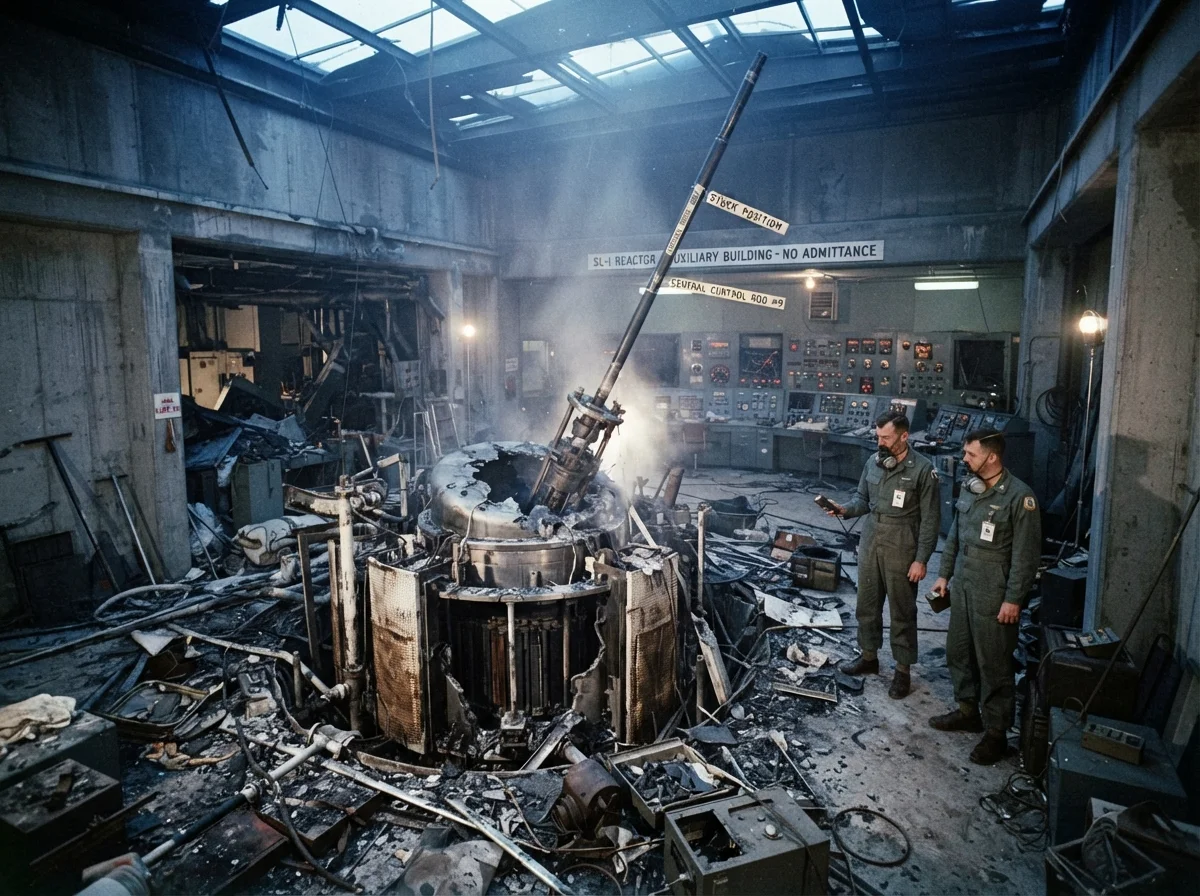
On the night of January 3, 1961, technicians tried to manually lift this rod by only 10 centimeters. Due to previous lockups, it likely jumped far beyond what was planned as soon as it released. In just 4 milliseconds, the reactor power surged from 3 megawatts to 20 gigawatts—more than six thousand times its nominal capacity. The instantly generated steam reached pressures of almost 700 atmospheres, launching the 12-ton steel vessel upwards and destroying everything around it.
The technical legacy in modern engineering
The accident was catastrophic, resulting in the immediate death of the three operators inside the room due to extreme exposure and physical trauma. The tragedy forced a radical change in global nuclear safety protocols: today, no design can allow a single mechanical piece to decide the fate of the entire chemical reaction on its own, even if it gets stuck in a high position.
The main lesson of SL-1 is that excessive simplifications for logistical purposes should never compromise essential safety redundancies. Currently, all modern reactors require multiple independent systems that ensure total shutdown, guaranteeing that isolated failures do not turn production machines into accidental weapons. It is a classic example of how robust design must always prevail over quick operational convenience.