Did the Large Hadron Collider find a new dimension?
Por Henrique Duarte ·
Modern physics faces one of its greatest mysteries when trying to explain why certain fundamental forces of nature behave so discrepantly among themselves. A classic example is the force of gravity; compared to other molecular interactions, it is absurdly weak, easily being overcome by the magnetism of a small refrigerator magnet against the entire mass of planet Earth.
To try and resolve this imbalance, scientists have explored theories involving the geometric properties of the universe's own fabric. One of the most influential proposals suggests that additional dimensions might exist beyond the three spatial ones (length, width, and height) and the dimension of time we habitually know. These hidden forms would serve as "paths" where gravity could be concentrated or diluted, explaining its fragile appearance in our daily reality.
This idea is not just a recent science fiction speculation, but has deep roots in the theory of general relativity. By proposing these extra structures, researchers seek to understand how the basic rules of the cosmos operate on scales so minuscule that our conventional senses and instruments simply cannot perceive directly.
The roots of a century-old theory
The search for this fifth dimension seriously began in the early twentieth century. In 1921, the German physicist Theodor Kaluza proposed a bold mathematical model by taking Einstein's equations on gravity and rewriting them using five dimensions. The result was fascinating: the new calculations automatically revealed the laws of electromagnetism along with gravity, uniting two distinct forces into a single mathematical structure.
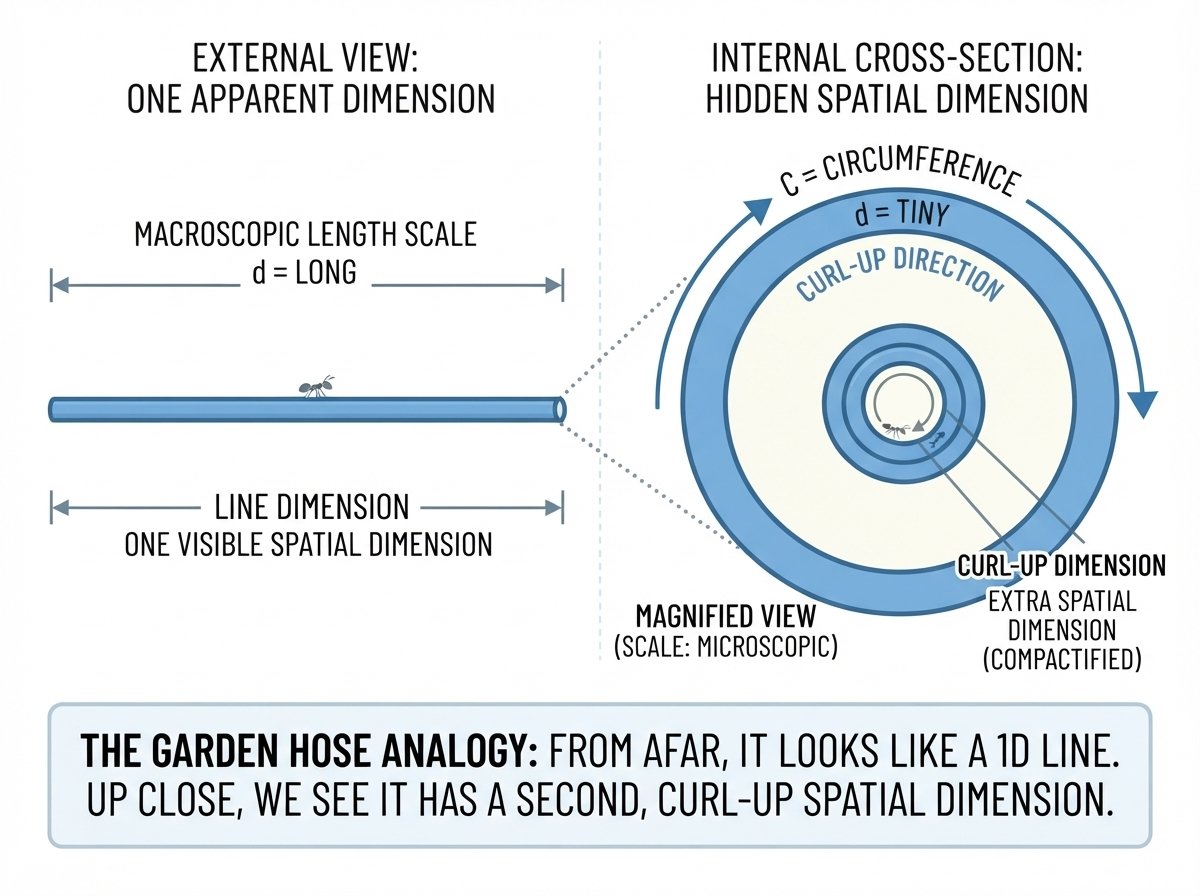
However, the practical problem immediately arose of knowing where this extra space would be, after all, if it truly existed. It was in 1926 that Oscar Klein offered a creative solution to this spatial question. He suggested that this extra dimension could be "compactified," meaning it is curled up on itself in circles so small that they would be invisible to the human eye, but would still influence the properties of subatomic particles.
To visualize this, think of a garden hose viewed from a distance; it appears to be just a simple one-dimensional line. However, an ant walking on the surface of that hose can complete a full loop, revealing a second dimension hidden in the curve of the tube. The theory applied to particles works the same way: they could traverse these micro-paths through compact dimensions without us being able to see the physical trajectory.
How particles gain invisible mass
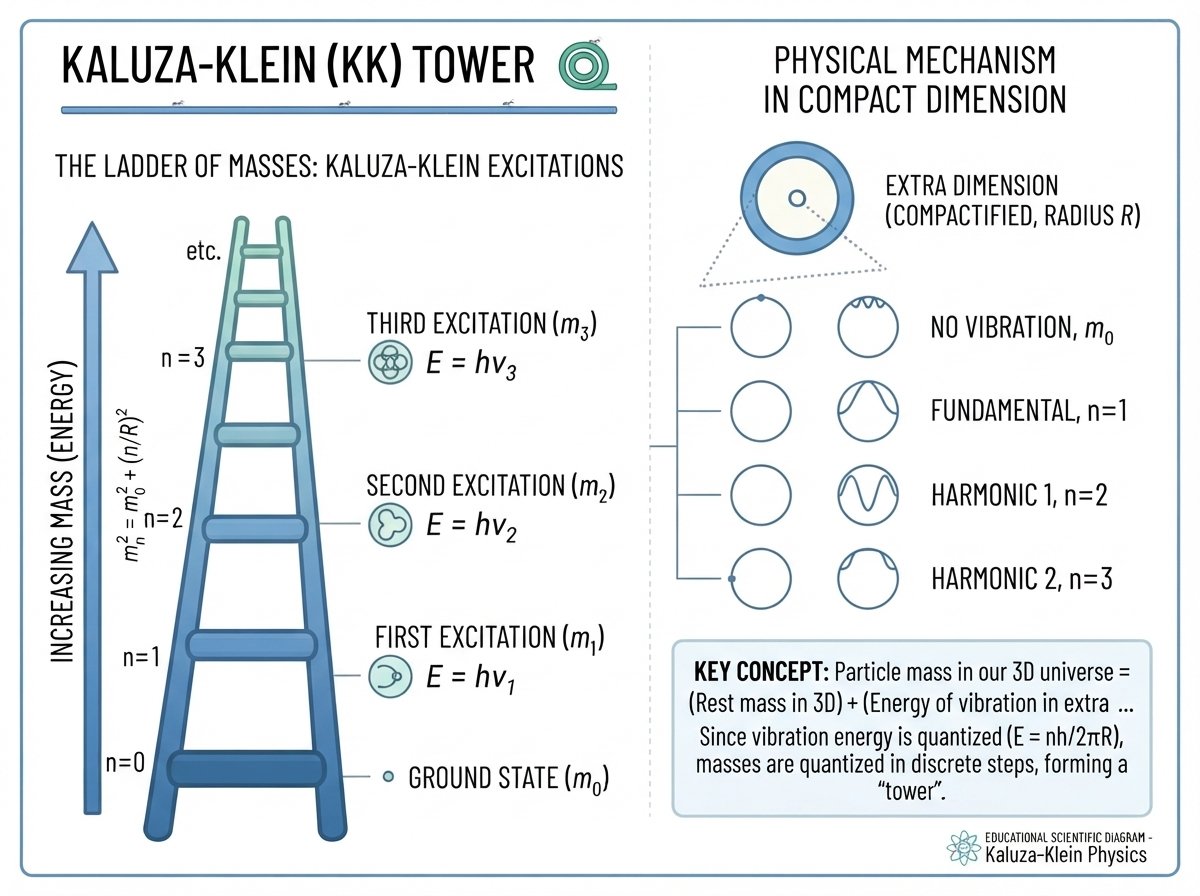
The connection between these invisible movements and what we observe in laboratories lies in the fundamental relationship between energy and mass proposed by Special Relativity. According to this rule, any movement generates energy, and all energy has a mass equivalent. If a particle is constantly orbiting or spinning in this small, hidden dimension, that movement gives it a specific amount of kinetic energy.
Even if it seems stationary to us in the traditional three-dimensional space, the energetic activity in this hidden "circuit" would cause the particle to be detected as if it had more mass. In physics, this phenomenon creates what scientists call Kaluza-Klein excitations. Imagine these excitations like the steps on a small ladder; each step represents a copy of the original particle, but much heavier due to the intensity of its oscillation in these dimensional curves.
Think of it like the strings on a guitar, which only vibrate at certain notes depending on their length and tension. The particle behaves like a quantum wave and must fit perfectly within these tiny circular dimensions. Because of this, they do not appear with random masses, but rather in specific intervals, creating repeated versions—almost like identical clones in terms of electrical charge, but different because of the extra weight accumulated by the invisible geometry.
Scaling the energy levels of the LHC
For decades, such copy particles would remain out of human reach because they would be too heavy for any apparatus capable of generating them. This changed in the 1990s, when theoretical models suggested that gravity is so weak precisely because it "leaks" or spreads out through these deformed extra dimensions. In these theories, the graviton—the hypothetical particle carrying the force of gravity—would have its first copies in this mass range achievable by our current experiments.
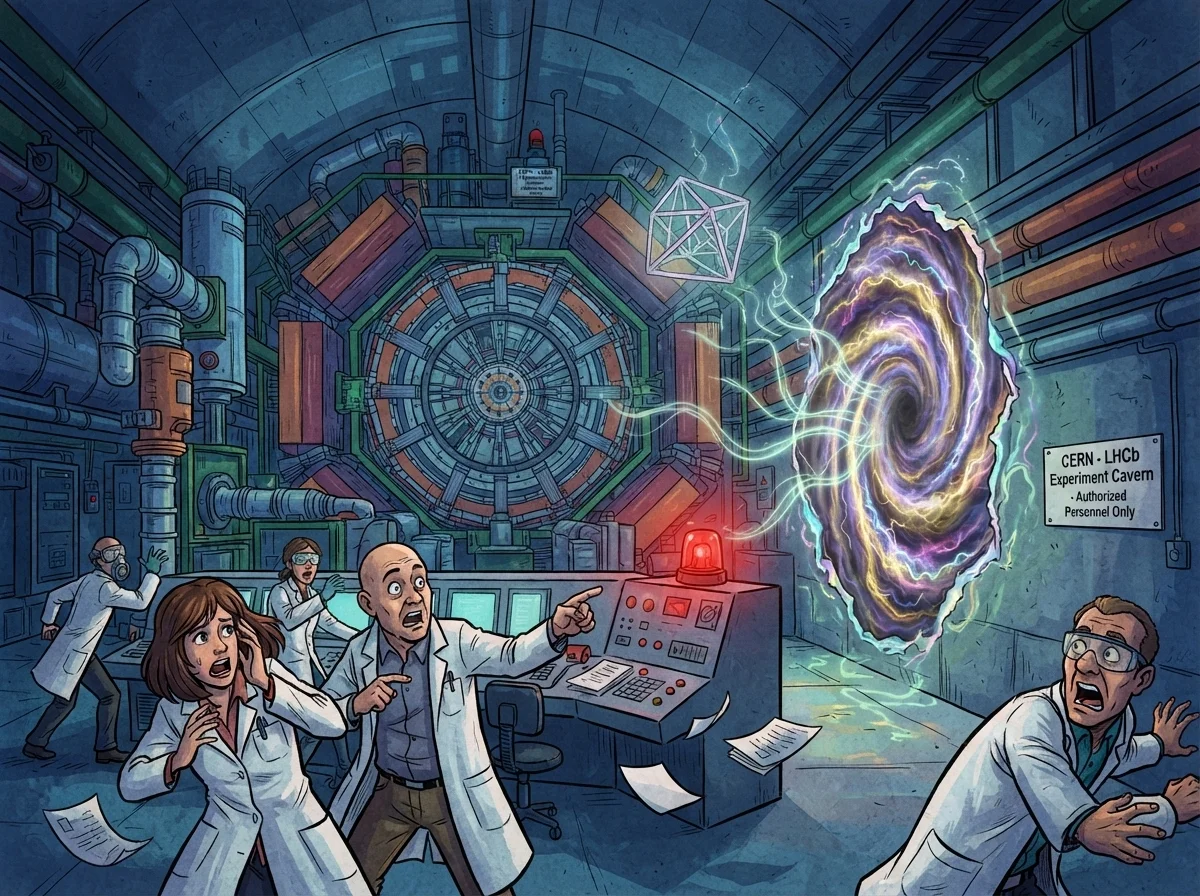
The Large Hadron Collider (LHC), operated by CERN, is where these clues are sought through violent collisions between protons accelerated to speeds close to that of light. When these protons collide with each other, the immense amount of energy released instantly converts into new subatomic particles. If one of these heavy particles exists, it would appear for an instant and quickly disintegrate into smaller components even before reaching the external sensors.
When one of these heavy parent particles fragments, its remnants form structures known as jets: rapid sprays of dozens of other particles traveling together in the same direction. The LHC's large detectors monitor these directions and the involved energies to try to reconstruct what the "mother" of this explosion was. This is how scientists attempt to identify signatures of new physics hidden amidst the chaos of the trillions of daily collisions performed by the machine.
Small deviations in the data graph
In March 2022, the CMS detector team presented intriguing results based on data collected up until 2018. They identified two specific collisions that appeared to involve four high-energy jets totaling eight tera-electronvolts—a unit of measurement used to calculate the masses of very high particles (one tera-electronvolt is equivalent to the approximate mass of a thousand protons). The behavior of these objects was not what was expected by the traditional laws of physics in effect at that time.
The anomaly lay in the fact that each pair of these jets possessed only about two tera-electronvolts, and mathematically, these values did not perfectly sum up to the total observed in the original collision. This suggested that something was missing or that some invisible property contributed to the final count. However, the statistical significance of this initial finding was low; there was a considerable chance that these two appearances were merely random coincidences within the vast number of tests performed by the accelerator.
To understand this, think about flipping coins: if you toss a coin several times and get ten heads in a row, it will seem like an incredible event. However, if thousands of people are tossing coins at the same time in different places, it is almost certain that someone will get that result purely by chance. In particle science, researchers must rule out this "chance" before declaring any real discovery, requiring evidence that surpasses the odds of mere mathematical coincidence.
A new lens to interpret what was seen
Recently, Alan Leet Yawang and François Richa published a new study proposing a different interpretation for those anomalous data points identified previously. They applied the theory of extra dimensions to suggest that those collisions could actually be signs of Kaluza-Klein excitations involving gluons—particles responsible for binding quarks—or even quarks themselves. Instead of just statistical noise, they saw possible patterns of hidden geometry.
The logic proposed by the authors utilizes the idea of the mass ladder mentioned earlier. For them, a smaller observed collision would be the first step of this subatomic ladder fragmenting into a lower level, while larger collisions would represent the second step of this process. The beauty of the model lies in its numerical consistency: when they performed theoretical calculations on how much each successive step should weigh, the results matched the real data captured by the CMS detector at CERN quite well.
This analysis does not automatically confirm the existence of new dimensions, but it significantly changes the academic weight of that old data. It offers a structured explanation behind phenomena that previously seemed isolated and meaningless within established theories. If these numbers remain constant in new tests, this mathematical pattern could become solid evidence confirming that we live in a spatially more complex universe than we imagine.
Where the pieces still don't fit
Despite the attractive theory presented by researchers from the University of Paris Saclay, there are important obstacles preventing any definitive statement right now. One of the main problems is that other independent detectors, such as Atlas, also located at the LHC, searched using the same parameters and did not find any excess corresponding to the two mentioned collisions. In experimental science, replicating the result using different equipment is essential to validate a discovery.
Furthermore, data collected between 2024 and 2025 suggests that these specific anomalies are not being repeated frequently enough in subsequent accelerator runs. There is also a significant theoretical contradiction: in the simplified model originally proposed, gravitons should appear significantly heavier than gluons or quarks in these extra dimensions. However, the authors' current calculations show them to be much lighter than expected by the very rule they are trying to prove.
These limitations indicate that the hypothesis is far from being considered an established scientific fact by many specialists. For now, it is a creative interpretation of ambiguous signals at the frontier of human knowledge. The field remains in a state of careful observation, where scientists are looking for new patterns capable of unifying the scattered evidence without directly conflicting with the physical laws proven to date.
Science searching for definitive proof
Currently, the honest answer as to whether the LHC found a new dimension is that we still don't know. The two strange events recorded in the data remain there as curious points on the results graph and may continue without a clear explanation, awaiting new technologies. It is important to note that none of the involved institutions—neither CERN nor the teams running the large detectors—has officially declared the discovery of any new dimensional space.
However, the published study provides clear goals for future experiments. If this cascade of heavy particles is real, the next levels of it should appear at very high specific masses, producing jets so energetic that nothing in traditional physics could easily explain. The research continues to advance as more data is collected in the current cycles of the accelerator, waiting for that magical moment when a clear signal finally separates itself from the statistical noise in the background.
Among the millions of billions of collisions occurring inside the giant machines in Switzerland, these small deviations represent the vanguard of our search for the unknown. It might just be a passing coincidence and they will disappear with new tests, but it could also be the first fragment of proof that there is a hidden universe folded upon itself, present in every cubic centimeter of the cosmos occupied by human matter.