The secret behind the turbo button on 90s computers
Por Arthur Bittencourt ·
The genesis of the clock and the repetition loops
To understand this technology, we must go back to the launch of the IBM PC 5150 in 1981. To reduce costs, IBM used a 14.31818 MHz crystal oscillator, derived from NTSC television production. Through the Intel 8284A chip, this frequency was divided by three, causing the Intel 8088 CPU to operate at 4.77 MHz. The problem arose because many developers created "empty loops" in assembly—basically asking the processor to count cycles until it reached a number X instead of using a real hardware timer.
Imagine asking someone to walk until they complete a thousand steps; if the person runs too fast, they will finish sooner than the observer expected. At the time, since almost all PCs had the same slow pace, these calculations worked perfectly. However, when new chips emerged (such as the 286, 386, and 486 architectures) and reached speeds between 8 and 66 MHz, these programs lost their temporal synchronization.
The practical impact on the user experience
In practice, this meant that classic games became impossible to play as soon as they started. In titles like Frogger or Digger, obstacles crossed the screen in fractions of a second because the program's internal counter reached its limit instantly due to the new CPU's superior speed. The computer was too fast for its own available software library, forcing a disruption in the natural evolution of gameplay.
Braking engineering: multiplexers and wait states
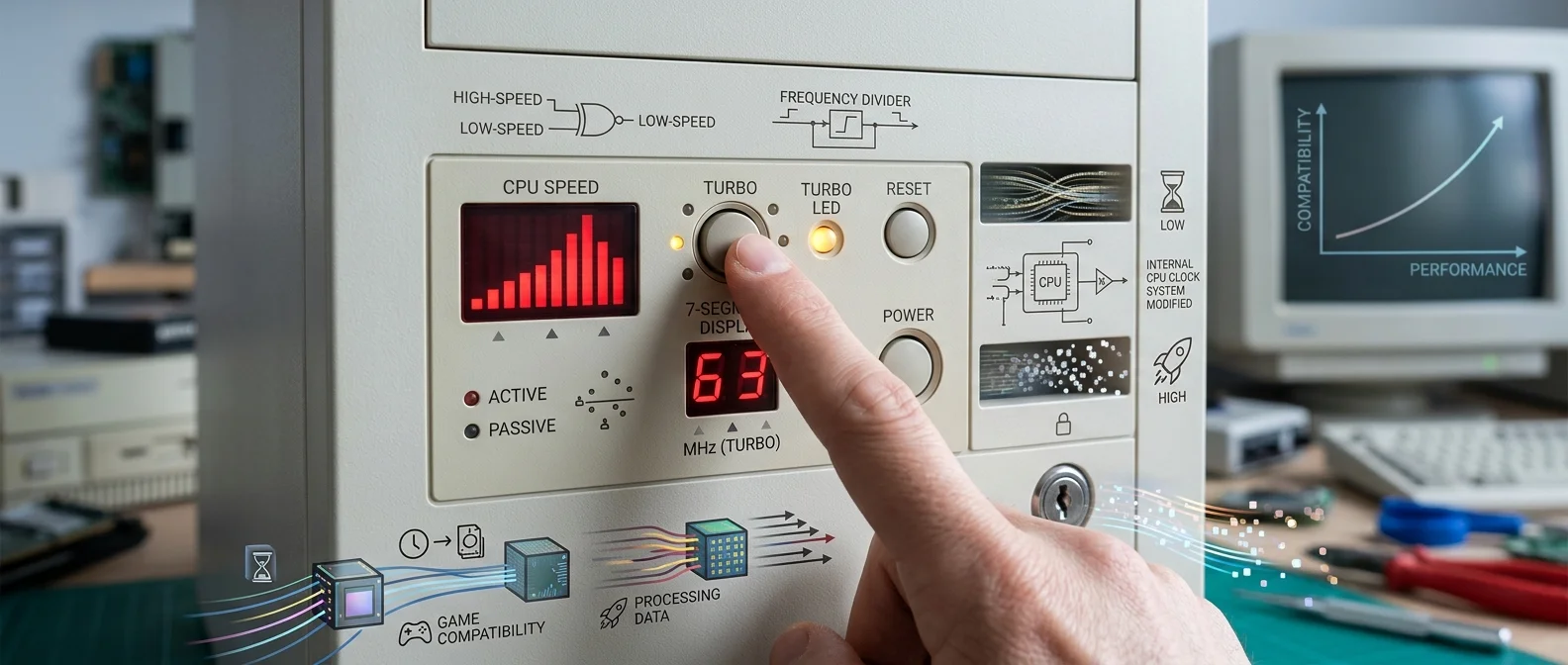
The commercial solution began with models like the Eagle Turbo XL, introducing physical switches on the chassis. In the early systems, these switches physically swapped the reference crystal via logic multiplexers. In more advanced motherboards, the button instructed the chipset to inject wait states—empty waiting cycles during communication with the RAM memory. It is like adding traffic lights to a highway to control the flow of cars; the CPU was forced to "wait" while fetching data, drastically reducing raw performance.
When Pentium processor frequencies reached 66 MHz, reducing the clock became unviable. The alternative was to halve the front bus and deliberately disable the L1 and L2 cache memories (small, ultra-fast storage units integrated into the chip). Without this cache, the processor lost its maximum speed and had to search for every byte individually in the slow main RAM, making the system mimic the sluggishness of an old computer.
Reverse marketing and the definitive transition
There is a historical irony here: the term "turbo" was a marketing blunder. In racing, turbo means extra power; in PCs, turbo mode was merely the nominal operation of modern hardware, while pressing the button applied a forced brake for compatibility. In Brazil, brands like Prológica and Microtec took advantage of this feature to sell competitive models within a market niche. Interestingly, the LED displays that showed these speeds were often just passive boards with manual jumpers, not reading the processor in real-time.
The definitive solution came with the shift in software engineering to the delta time technique, where the code measures the exact interval between frames regardless of the CPU speed. With the Intel ATX standard in 1995, physical switches were eliminated from motherboards. Today, if you are developing or preserving classic games, the recommendation is to adopt engines that use delta time or specific emulators, because relying on physical clock limits no longer makes sense in the modern architecture of multitasking operating systems.