Neuralink Patient Plays GTA 6 Using Mental Commands
Por Arthur Bittencourt ·
Neural Technology in Action in GTA VI
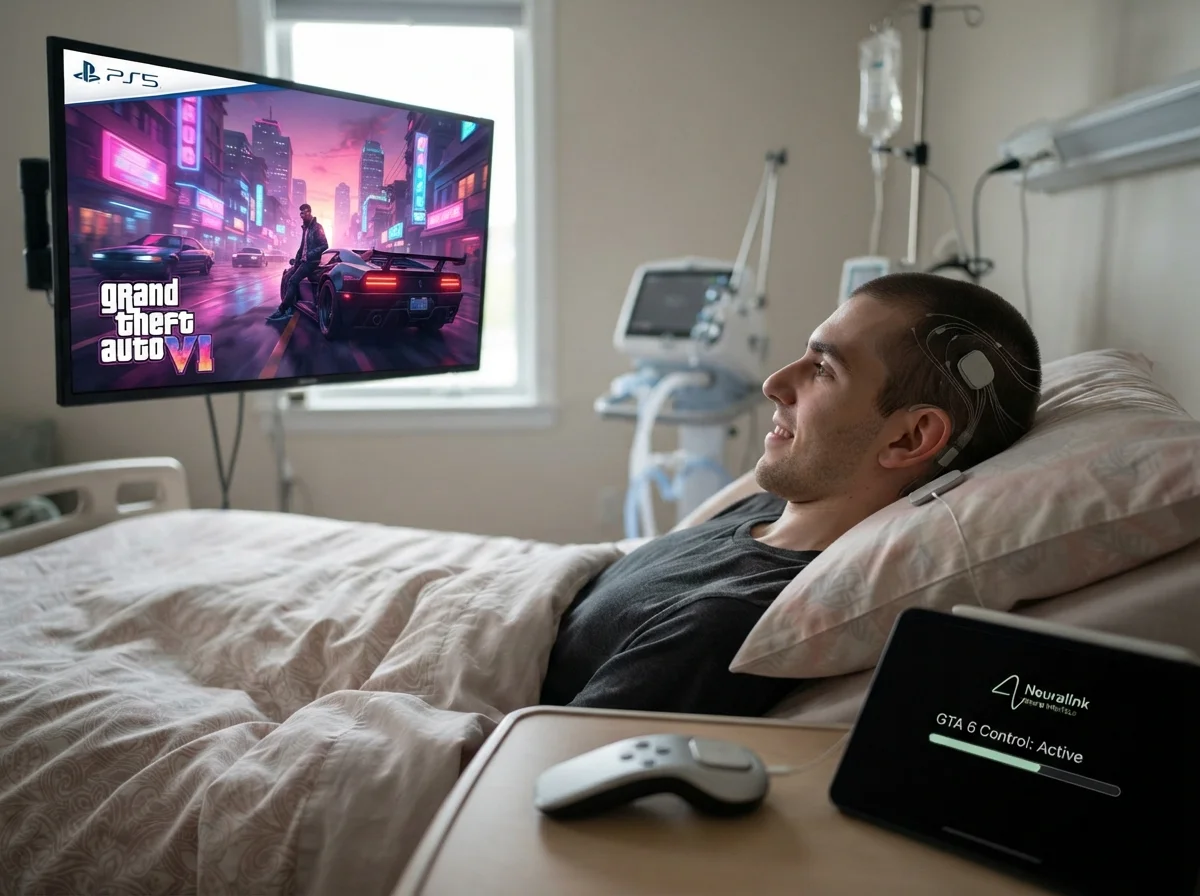
Recently, the company Neuralink revealed an important milestone in human-machine interaction by showing a user playing Grand Theft Auto VI without using any traditional physical peripheral. The research participant, identified as Billy, is a person with tetraplegia caused by spinal cord injury and managed to navigate the game using exclusively brain impulses captured by an implant.
During the demonstrations provided by the company, it was possible to observe Billy performing complex gameplay actions, such as piloting aircraft, driving vessels, and participating in combat. All this execution depends on the direct conversion of electrical signals from the brain into commands that would normally be triggered by a manual controller. The recording took place during the title's launch, serving as proof of concept for the potential of these direct interfaces.
How the Mind Translates into Digital Movements
The functioning of this system is based on the decoding of neural intentions—patterns of electrical activity in neurons that signal movement desires. Think of it as an electronic bridge: when the player "imagines" performing a specific gesture, the software identifies that pattern and instantly maps it to corresponding inputs on the PlayStation 5 console.
In the observed case, Billy can manipulate two analog sticks and up to 12 different buttons just through thought. For example, when mentally visualizing the touch of the ring finger, the system automatically activates the Square button for attacks. Other mental projections simulate hand movement, allowing him to change the direction of the ship or vehicle within the game's virtual environment.
A Radical Shift in Accessibility Access
To understand the real impact of this technology, one must look at the previous alternatives. Before receiving the brain implant, the user relied on a mouth stick to operate an iPad, a method that causes considerable physical discomfort and drastically limits reaction speed and the complexity of possible movements in a 3D environment.
The new interface completely eliminates this physical barrier, transforming immediate intent into digital action without requiring motor effort in the upper limbs or face. This represents a significant evolution for players with severe disabilities, as it removes the mechanical limitations of external hardware and places autonomy directly into the individual's thought process during the game.
Technical Limitations and Current Regulatory Status
Although impressive, the results demonstrated by Neuralink should still be viewed with caution regarding their immediate commercial use. The company has made it clear that these records are merely technological showcases, lacking FDA (Food and Drug Administration) approval or consolidated clinical validity at this time, functioning more as a demonstration of raw technical capability.
So far, specific technical details regarding long-term data or additional tests beyond basic inputs have not been officially disclosed. Therefore, while the advancement is evident, the path between this controlled experiment and a product available for large-scale use still involves rigorous safety processes, constant performance validation, and precise improvements in the latency of commands captured by the brain chip.