Why engineering and physics limit GTA 6 to 30 frames per second
Por Henrique Duarte ·
The time budget for each image
To understand why a game runs at a certain speed, we must first understand the concept of a frame. Every scene we see on the screen is an image calculated from scratch by the hardware, where the system needs to decide the position of objects, the direction of light, and the projected shadows.
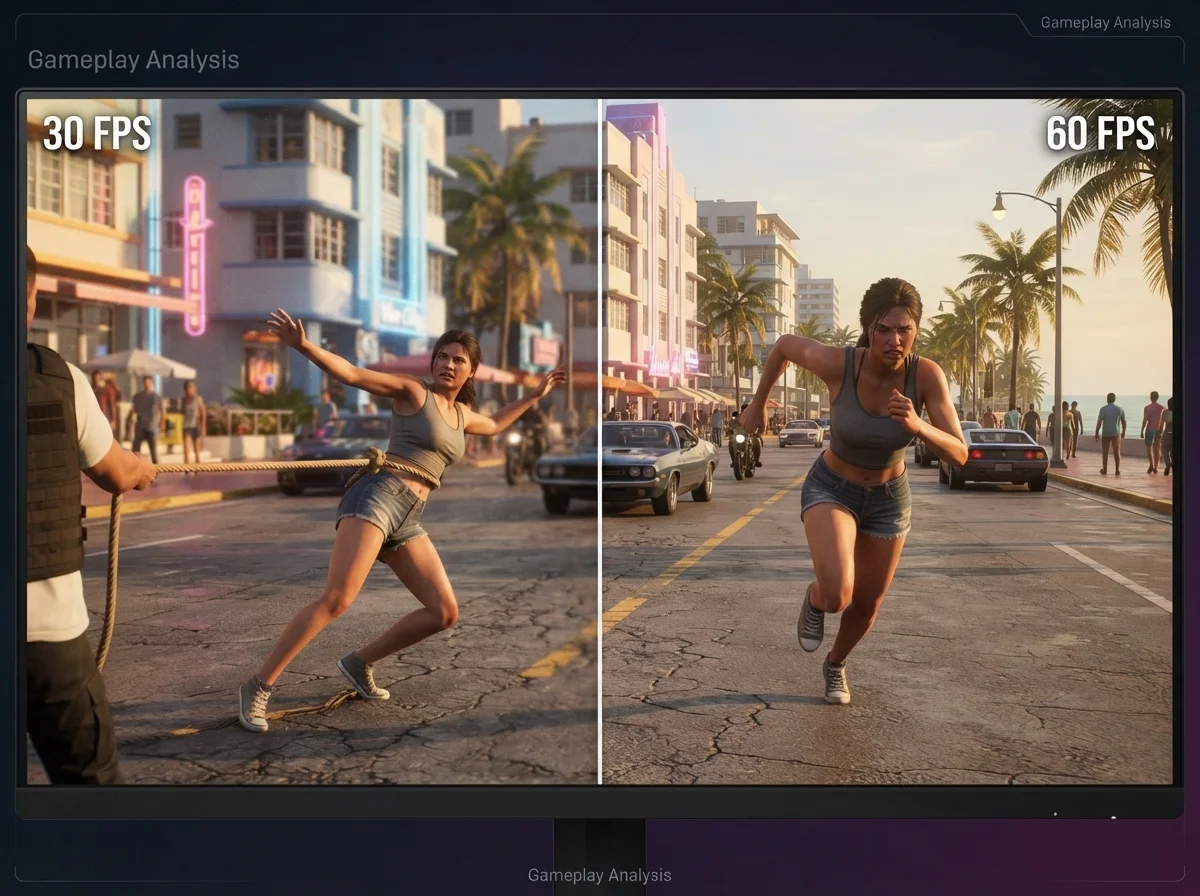
When we talk about 30 frames per second, we are telling the computer that it only has 33.3 milliseconds to complete all that work before displaying the next image. If we double that goal to 60 frames, that time drastically drops to about 16.7 milliseconds. It's like the time "budget" is cut in half, requiring much more efficiency from the internal components.
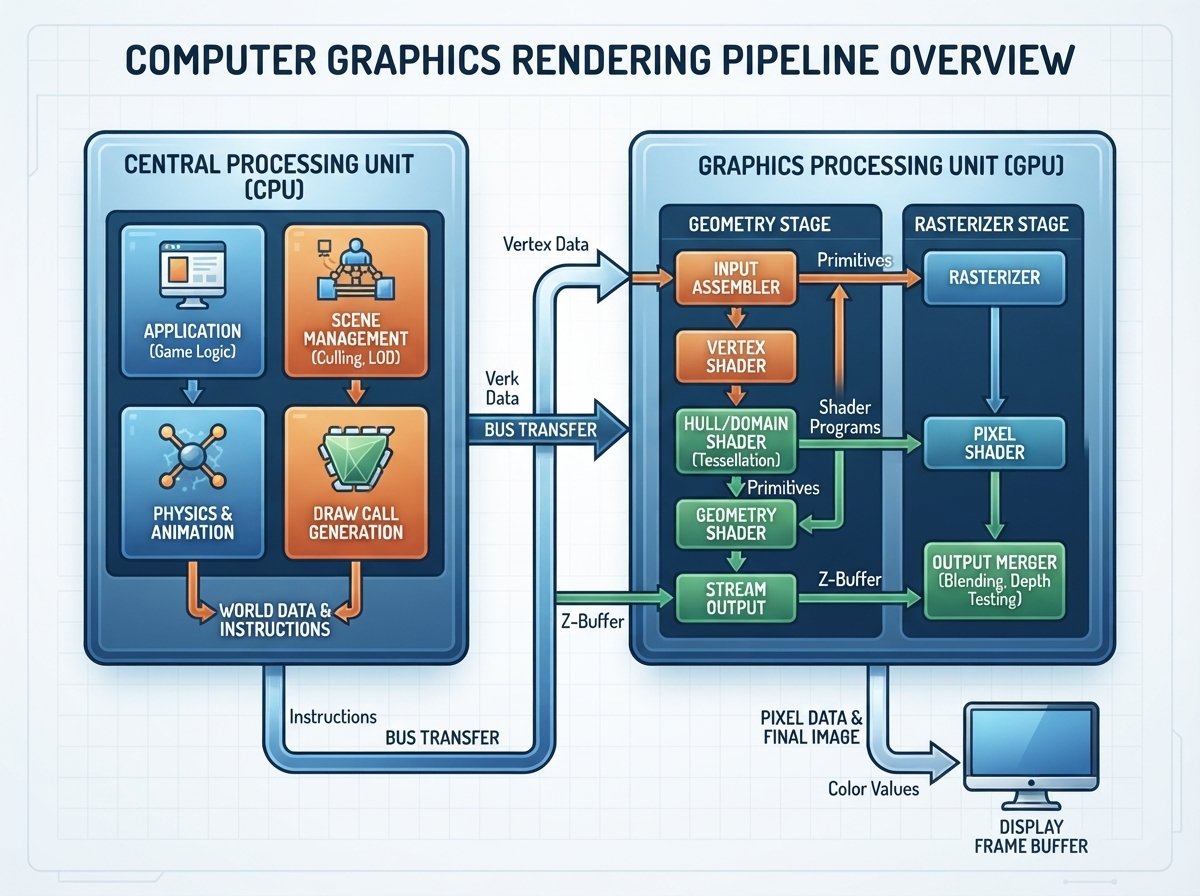
In this process, two main actors divide the task: the CPU (Central Processing Unit) and the GPU (Graphics Processing Unit). The CPU acts like a logistics manager, deciding what happens in the world, moving traffic, and calculating physics. The GPU, meanwhile, acts like a mass renderer, transforming these instructions into colored pixels. They work in sequence, like an industrial assembly line, where the final output cannot be faster than the slowest step in the process.
Why lowering the resolution doesn't always solve the problem
Many players believe that lowering the resolution is the magic solution to gain more smoothness, because it directly reduces the strain on the graphics card. A high-definition image requires millions of calculations per pixel; by reducing that count, the GPU truly gets a break to render the scene with less load.
However, there is an important limit to this reasoning related to the game's logic. Even if the image looks less sharp, the number of characters on the street and the decisions each pedestrian makes remain the CPU's responsibility. If the software's "brain" is overloaded trying to manage a thousand people simultaneously, the game will continue to lag or run slowly, regardless of how many pixels need to be painted.
This dynamic has been observed in recent titles, where performance drops in dense areas have been attributed almost entirely to the AI processing of NPCs (non-playable characters). This shows that modern visual fidelity has created such a high demand for world simulation that often little time is left just to increase the image speed.
The technical dilemma in next-generation hardware
With the release of more powerful consoles, such as the PlayStation 5 Pro, the question arises as to why they still don't guarantee stable 60 frames in all games. The new console has significantly superior computing units, but this extra power is strategically distributed by developers based on the title's priorities.
In the case of GTA 6, evidence suggests that the company chose to use this additional power to raise the density and quality of textures, instead of just doubling the refresh rate. This involves technologies like PSSR, an upscaling method that uses machine learning to make the image sharp while maintaining complex shadows through ray tracing.
Rockstar's choice reflects a balance between information volume and fluidity. When a game tries to keep many objects reacting simultaneously to the environment, every millisecond saved on the GPU may be insufficient to compensate for the heavy load on the CPU. Currently, it seems that the effort required to maintain world integrity prevents a simple increase in frames without compromising everything that makes the game special.
The barriers of parallel processing
A common solution would be to add more cores to the processor, but here comes a mathematical rule known as Amdahl's Law. It explains that part of a program cannot be divided among several "workers" because certain tasks strictly depend on previous events; it's equivalent to saying you can only bake a cake after mixing the batter.
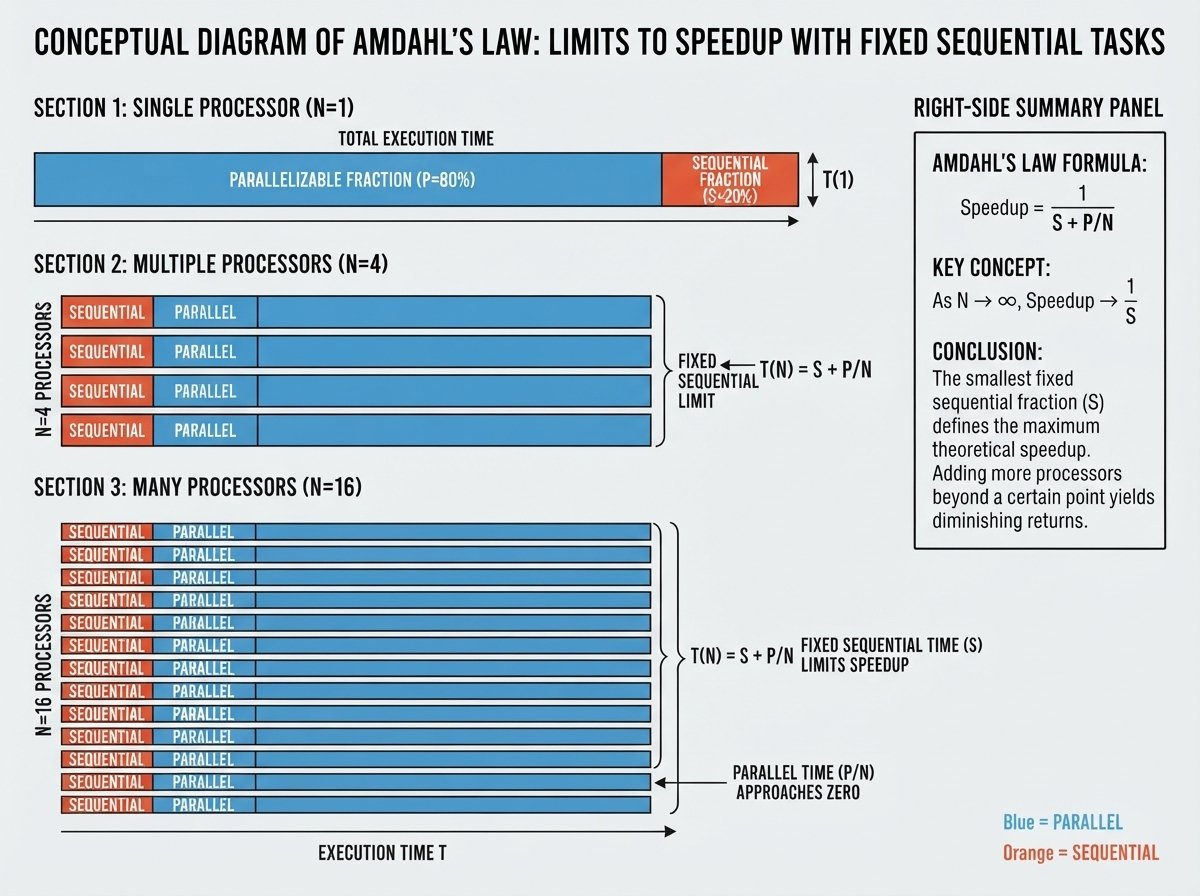
In an open-world game scenario, certain calculations need to happen in sequence: for example, the system must calculate if a collision occurred before deciding which impact animation should happen. These sequential parts limit the total speed gain from new cores. If 20% of a game's actions are mandatorily sequential, even if we had infinite processors, that portion would remain the final bottleneck.
For this reason, small increases in the clock speed (the operating frequency) of existing cores are just as valuable as having many slow cores. The PlayStation 5 Pro offers exactly this small performance jump to try and push these critical processes. However, every increment in this area faces serious physical and thermal limits that make revolutionary advances difficult in the short term.
When thermodynamics dictates the rules
Increasing a chip's speed requires more energy, and this relationship is not linear, but exponential. The power consumed grows proportionally to the square of the voltage and the cube of the component's frequency. This means that doubling the processor's speed could drastically multiply the heat generated, turning the console into an inefficient and dangerous heater for the internal circuits.
To prevent the silicon from melting or losing efficiency due to overheating, manufacturers design consoles with fixed watt ceilings. They operate like closed boxes where cooling limits how much electricity can be converted into simultaneous processing. If we are already close to this energy limit, significantly increasing the frame rate would require a radical change in how we handle heat.
Although there are fundamental theoretical limits, such as the Landauer Limit—which defines the minimum energy expenditure to process a bit of information—today we face practical engineering barriers. The current challenge is not just the basic physics of atoms, but how to manage millions of transistors working together without exceeding the thermal capacity allowed by the device's design.
Physical simulations and numerical errors
Within the game code, physics itself follows mathematical laws that can generate problems if calculated incorrectly. Games rarely simulate movement continuously; they use discrete time steps to advance object positions according to Newton's laws. If these intervals are too large, small errors begin to accumulate, creating strange phenomena.
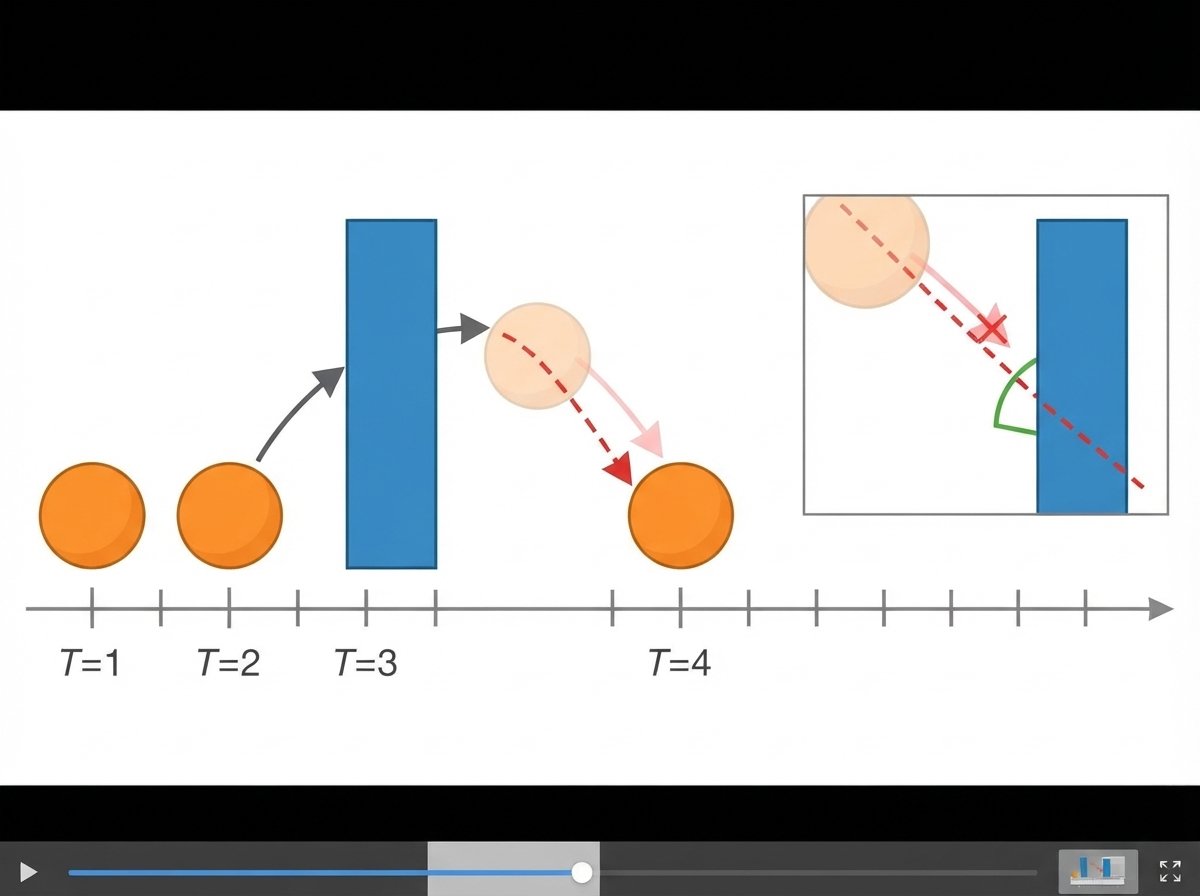
A classic example occurs in calculating a car's suspension using simple mathematical methods: the accumulated error can cause a spring to gain energy "out of nowhere," making it swing harder and harder until it virtually explodes. Another common problem is what is called wall clipping, where high-speed objects jump over obstacles because their displacement between two frames was greater than the thickness of the solid object.
To prevent this, developers use complex systems like Rockstar's Euphoria engine, which attempts to maintain the consistency of these interactions. However, these simulations are computationally heavy. Keeping bodies reacting realistically requires constant processing at every millisecond step, reinforcing the idea that the more realistic the internal physics, the less flexibility there is to increase the visual frame rate.
The exhaustive mathematics of light
Another fundamental pillar of GTA 6 is lighting, governed by the Rendering Equation. Mathematically, this equation describes how the color of each pixel depends on all the light reaching it from all directions. Solving this perfectly would require infinite calculations within complex integrals, something impossible to achieve in real time with current technology.
Ray tracing functions as a smart approximation of this reality, launching virtual rays to calculate shadows and reflections. However, every ray launched consumes a precious piece of the console's energy budget. If we divide the number of frames by two, we would have half the rays available for each image, which would result in much more "noise" or grain in the player's view.
To compensate for this noise with fewer resources, the software must apply sophisticated filters that attempt to guess where the light should be. This is where the tension between fidelity and performance lies: if we want perfect images without blur, we need a lot of data; if we reduce that data to gain frames, we lose the visual clarity that defines Rockstar's new graphical generation.
Harmonic mean and display patterns
There is an elegant mathematical solution to try and balance 30 and 60 frames, based on the harmonic mean, which results in about 40 frames per second. This value is interesting because it allows the system to provide the same constant time interval for every frame on the monitor, preventing the images from looking shaky or unsynchronized.
This explains why some games use specific modes for high-frequency televisions (120 Hz). By ensuring that every frame lasts exactly the same amount of milliseconds on the screen, the visual experience becomes smooth even if it is not running at the maximum possible speed. Recently, clues in the console files suggest that this approach can be explored in the future to offer a middle ground between the current extremes.
The final decision on how to present these images depends on the game's technical design. If each frame lasts for different amounts of time—alternating between fast and slow—the human eye will perceive this as a lack of fluidity, creating a temporal "choppiness." Maintaining a fixed and stable rhythm is essential for immersion, regardless of whether that number is 30, 40, or 60.
Human perception vs. cinematic blur
It is often argued that the human eye can only perceive up to 30 frames per second, but science shows that our vision works differently. The visual system perceives much faster variations than that; what truly matters for the perception of smoothness are the transitions between the lights and shapes presented in sequence.
In cinema, 24-frame movies appear fluid thanks to the motion blur effect. Since the camera remains open during capture, the resulting image naturally has a trail of moving objects. In video games, however, each frame is usually a sharp, instantaneous photograph, without any natural blur, which makes the jumps between them much more evident to our brain.
This difference causes 30 frames in a game to potentially look less fluid than 24 in a movie, because the eye tries to track a constantly moving object while the screen "jumps" position every few milliseconds. Even NASA research confirms that these small visual jerks occur when we try to follow fast objects on digital screens. Thus, the limit of GTA 6 is a complex combination of hardware engineering, physical heat limits, and artistic choices about how our eyes interpret virtual reality.