TCL develops 120 Hz screen for low-power notebooks
Por Arthur Bittencourt ·
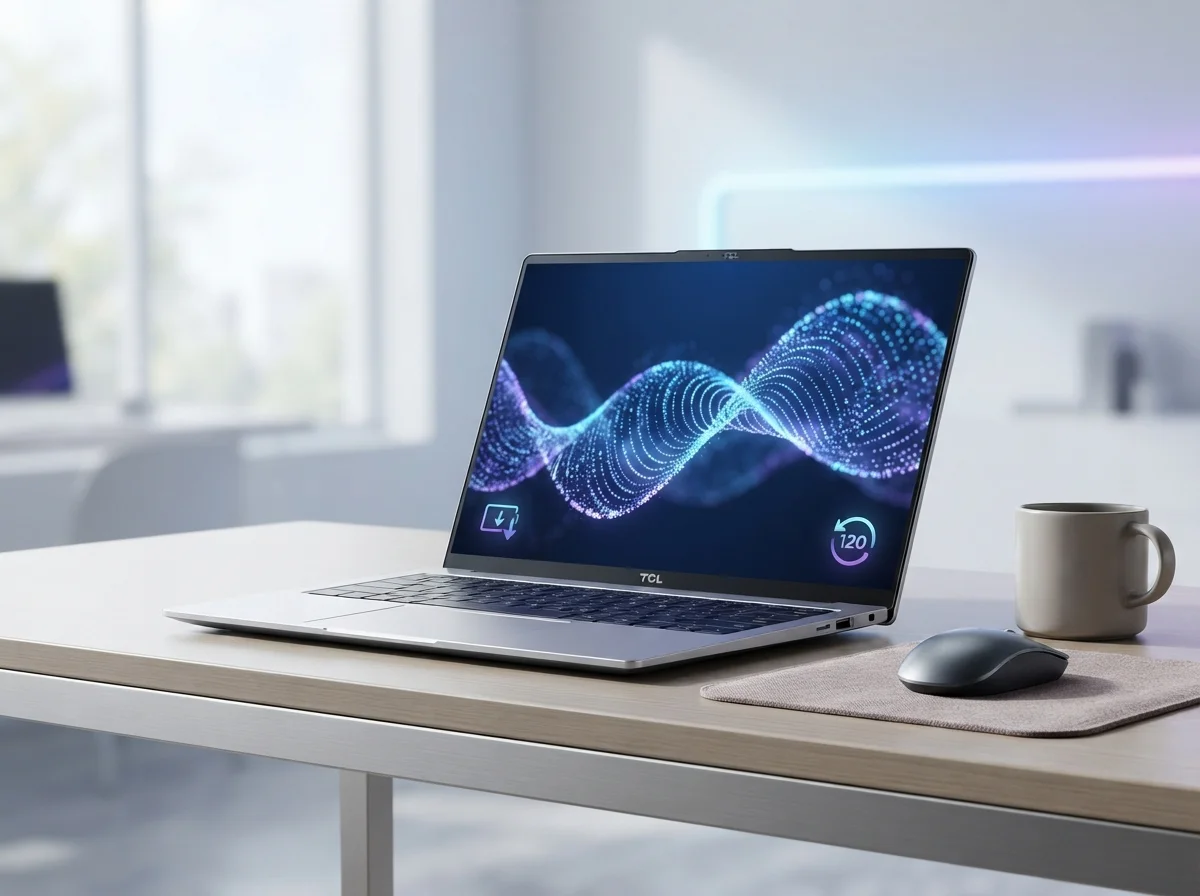
During the Display Technology Conference (DTC) 2026, the company TCL CSOT revealed a significant innovation in the display sector: a 14-inch screen module designed specifically for laptops. Presented integrated into what appears to be a prototype of the Lenovo Yoga Pro, this technology allows devices to operate with an adaptive refresh rate of up to 120Hz. This frequency refers to the speed at which images are refreshed on the screen per second, providing much smoother motion during video playback or system navigation.
Efficiency through high-transmittance design
The key differentiator of this component lies in its ability to operate in a "milliwatt class," keeping the total consumption below 1W for the entire Liquid Crystal Module (LCM). To achieve this standard, the manufacturer applied a high-transmittance design, which optimizes light passage through the panel layers without compromising visual sharpness. Imagine how a perfectly clean pane of glass facilitates internal viewing while saving effort; the technique works similarly to minimize the load on the electrical circuit and maximize luminous efficiency.
Technical comparison and weight reduction
The technological difference becomes evident when we compare these numbers with the conventional IPS screens currently used in 14-inch notebooks. While standard models typically consume between 3W and 4.5W—and can exceed 8W in high-resolution versions—the new TCL module cuts almost all of that energy demand. Furthermore, there is a drastic reduction in physical hardware: this component weighs only 100 grams, surpassing traditional modules that weigh between 250g and 350g. With an ultra-thin construction, it allows for the development of much lighter and sleeker devices.
Product limitations and commercial outlook
Although the advancement is promising, there are still points that need to be validated before it officially hits the market. The ultra-thin structure naturally raises questions about its physical resilience against impacts or constant pressure when the notebook is closed. Furthermore, complete tests of real-world battery life were not provided, as other internal components directly influence energy drain. Currently, the technology is in a demonstration phase, but mass production is projected to occur around 2027. For now, it is a significant technological indicator for those seeking energy longevity without sacrificing superior visual fluidity.